
AI engines don't rank the market; they reconstruct a recommendation from whichever brand they can describe with the most confidence, and that is very often not the biggest one. A market leader with a top Google ranking, a bigger domain, and more backlinks routinely loses the AI answer to a smaller competitor with cleaner entity signals, more third-party mentions, and content the model can quote without guessing.
Key Takeaways
- AI-cited sources overlap with Google's top 10 results only 11.9% of the time, and 80% of AI citations don't rank anywhere in Google for the same query (Ahrefs, 15,000 queries).
- Among brands ChatGPT treats as a category's "owner," organic traffic was actually higher than the runner-up's in only 48.4% of cases, barely better than a coin flip (Semrush, 50,000 brands).
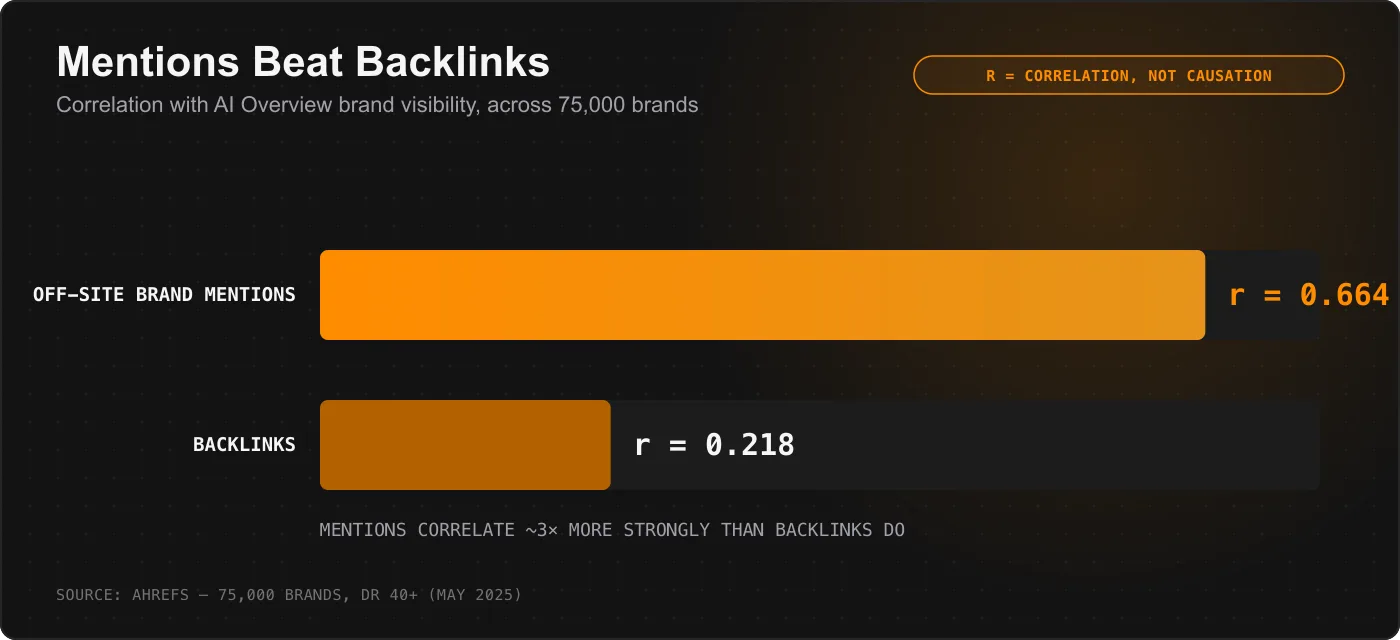
- Off-site brand mentions correlate with AI visibility three times more strongly than backlinks do: 0.664 versus 0.218 (Ahrefs, 75,000 brands).
- When Google's AI Overviews cited a company's own "best tools" listicle, it excluded that company from the recommendation and named competitors instead 69% of the time (Search Engine Land audit).
- 69% of B2B buyers say an AI chatbot changed which vendor they picked, and a third bought from a brand they'd never heard of (G2, 1,076 buyers): the commercial cost of losing the AI answer.
Definition: AI Recommendation
An AI recommendation is the set of brands a generative engine names when a buyer asks for a suggestion, a comparison, or a shortlist, as distinct from a citation, which is simply a source link the model shows its work with. An engine can cite a company's own article and still recommend that company's competitors from inside it: citation proves the model read your page, not that it trusts your brand. This is a companion piece to our guide on Generative Engine Optimization and focuses specifically on the moment a competitor gets named instead of you.
Why doesn't ranking #1 on Google get you recommended by ChatGPT?
Most marketing leaders reach for the same instinct when a client asks why a competitor showed up in a ChatGPT answer: check the SERP, check the backlinks, check what the SEO team is doing differently. That instinct is now measurably wrong.
Ahrefs ran 15,000 long-tail queries through Google, Bing, and four AI assistants side by side, then checked whether the pages the assistants cited also ranked in the traditional results for the identical prompt. The overlap with Google's top 10 averaged just 11.9%, ranging from 28.6% for Perplexity down to 6.1% for ChatGPT's reference links. Eighty percent of AI citations didn't rank anywhere in Google for that query, not page two, not page ten (Ahrefs, August 2025).
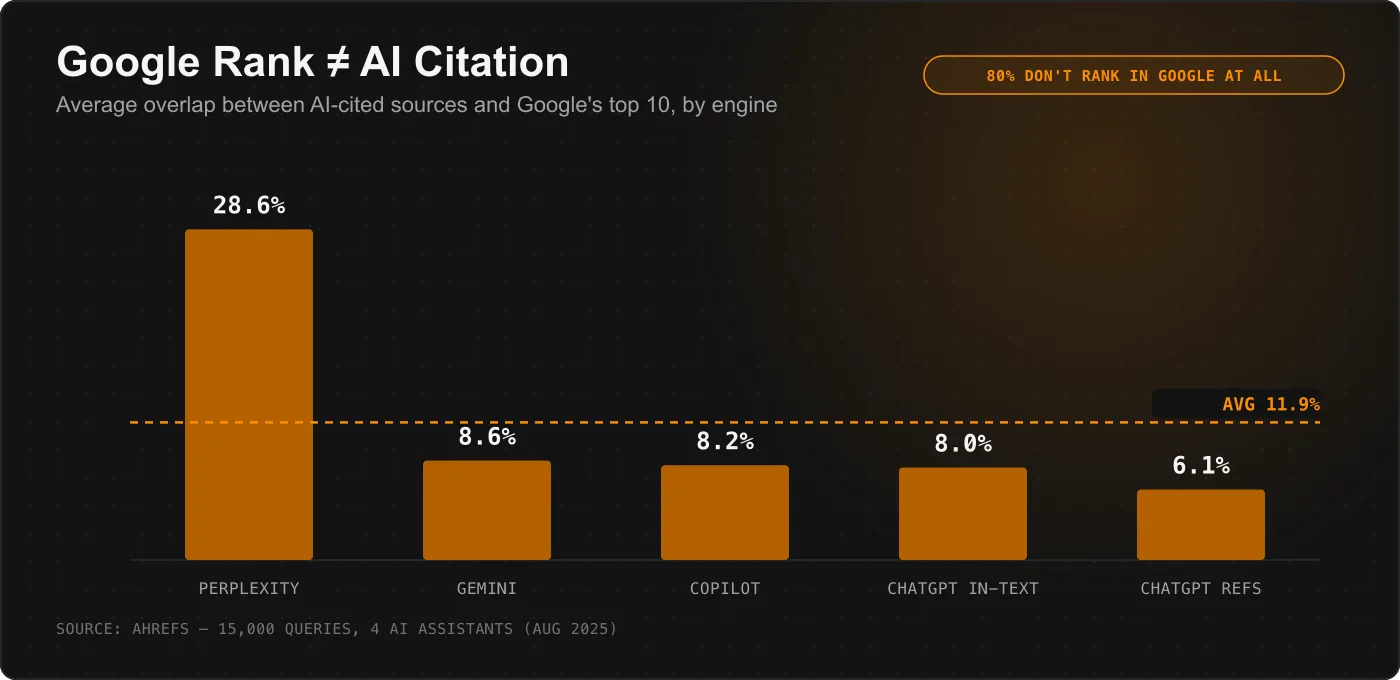
That is not a rounding error. It means the SEO team's dashboard and the AI engine's answer are drawing from almost entirely separate evidence pools. A page can hold position one on Google for years and still never appear in a ChatGPT answer for the same question, because the model isn't reading the SERP. It's retrieving whatever it can verify fastest from the sources it already trusts.
Does market share or brand size decide who AI recommends?
Not reliably, and the newest large-scale study on the question covers more brands than any single marketer's Google dashboard ever will. Semrush and independent analyst Kevin Indig tracked 1,094 U.S. categories across more than 50,000 brands in ChatGPT from January through June 2026, comparing whichever brand ChatGPT named most consistently (the "category owner") against its closest runner-up (Semrush, July 2026).
The traditional SEO scorecard barely predicted the winner:
| Signal | Owner led the runner-up | Read against a coin flip | |---|---|---| | Branded search volume | 55.7% of pairs | Weak, but the only statistically significant edge | | Domain Authority Score | 52.5% of pairs | Effectively random | | Organic traffic | 48.4% of pairs | Below random |
On raw organic traffic, the category "owner" was very slightly less likely to be the bigger site than the runner-up. Ownership itself is also rare: only 15.2% of the 1,094 categories had a brand consistent and dominant enough to count as a clear owner at all. The other 84.8% were open contests where the named brand could flip from one prompt to the next (Semrush, July 2026).
How does AI end up recommending your competitor, specifically?
The clearest documented mechanism comes from a practitioner's own audit, and it should unsettle anyone who has published a "best tools for X" roundup as link bait. SEO researcher Lily Ray tracked 100 B2B software queries through Google's AI Overviews across three checkpoints and found the same pattern repeating: Google would cite a company's own comparison listicle as a source, extract the competing products that listicle named, and recommend those competitors instead of the company that wrote it. Across 323 citations of self-promotional listicles, that happened 224 times, 69% of the time (Search Engine Land, June 2026).
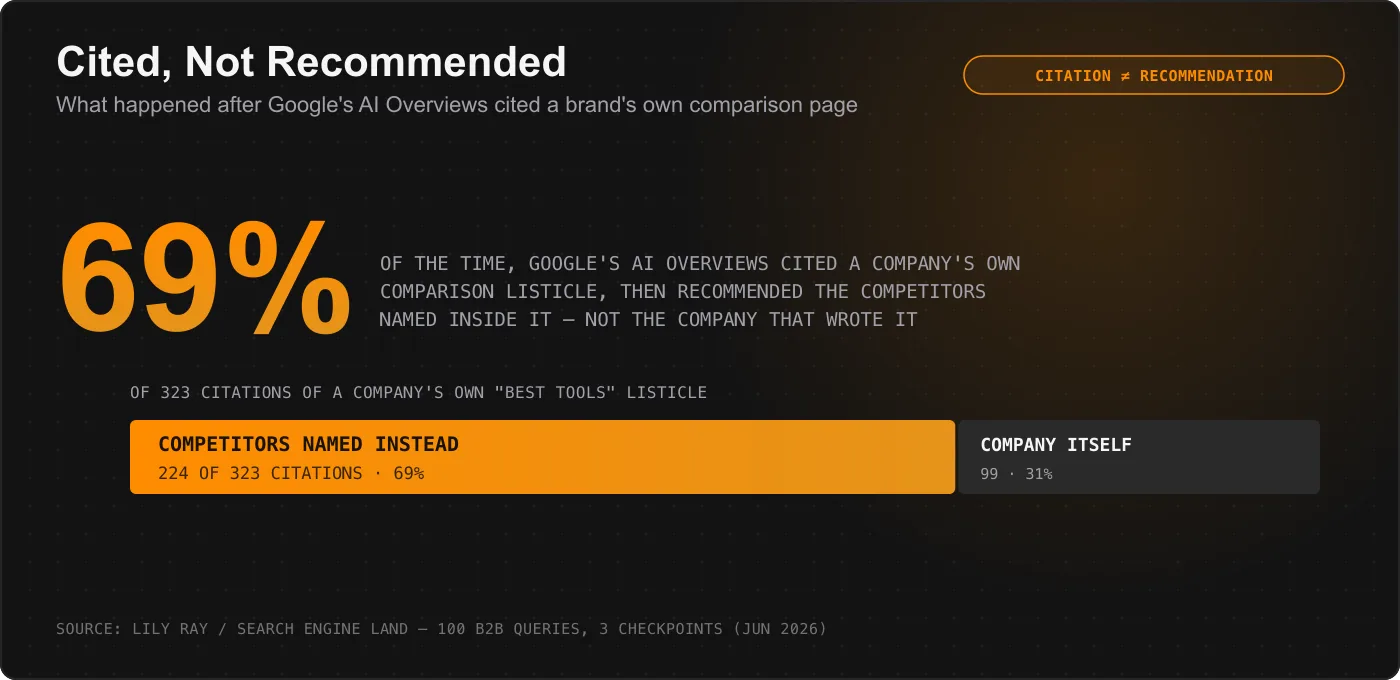
Read that mechanism twice, because it is the honest answer to "why does AI recommend my competitor instead of me." The model isn't punishing you. It's using your own page as a directory and reading past your byline to the names inside it. A citation on the page proves the model found and trusted your content enough to source from it. It says nothing about whether the model trusts your brand enough to suggest it, and those turn out to be two different jobs a single page has to do.
What actually predicts whether AI recommends you instead of a competitor?
If size and rank aren't the lever, the evidence points somewhere more specific: how consistently your brand is described by sources other than you. Across 75,000 brands, Ahrefs found that off-site brand mentions (being named, without even a link, on other people's pages) correlated with AI Overview visibility at 0.664. Backlinks, the metric an entire SEO industry was built to chase, correlated at just 0.218 (Ahrefs, May 2025). Brands in the top quartile for web mentions averaged 169 AI Overview appearances; the bottom half averaged zero to three.
The honest counterweight belongs here too, because a lot of GEO advice overpromises on this exact point. Ahrefs later ran a matched experiment adding schema markup to 1,885 already-cited pages and tracked citations for 30 days before and after. AI Overview citations fell 4.6%; ChatGPT and AI Mode citations moved a statistically insignificant 2%. Schema didn't buy those pages more citations, because they were already legible enough to be cited (Ahrefs, May 2026). We've written about why schema still matters for AI search as a legibility floor rather than a ranking lever, and this study is exactly why that distinction holds. The lift comes from being talked about accurately in places you don't control, not from markup on pages you do.
Key takeaway: Off-site brand mentions predict AI visibility three times better than backlinks do. Schema and technical fixes are table stakes for legibility, not a lever that pushes an already-cited page higher.
What's actually at stake if AI keeps recommending your competitor?
This isn't a visibility metric with no revenue attached to it. G2 surveyed 1,076 B2B software buyers in March 2026 and found that 69% chose a different vendor than the one they'd originally planned to buy, because a chatbot suggested it, and a third bought from a brand they'd never heard of before the AI named it (G2, April 2026). Eighty-five percent said they thought more highly of a vendor simply because an AI answer had included it.
Similarweb's behavioral data shows the same pattern downstream: brands ChatGPT recommended were 2.5 times more likely to get a website visit within seven days than brands it left out, and those visitors browsed nearly twice as many pages and stayed about twice as long once they arrived (Similarweb, June 2026). Being left out of the answer doesn't just cost a mention. It costs the visit, the comparison, and increasingly the deal, before your sales team ever gets in the room. The gap shows up directly as a competitor pulling ahead in AI share of voice for the exact questions your buyers are asking; if B2B software is your category, see GEO for SaaS for how this plays out on the buyer side specifically.
Is there a reliable way to make AI recommend you instead?
Not a permanent one, and anyone selling a guaranteed #1 AI ranking is selling something the data doesn't support. SparkToro tested this directly: across 2,961 responses to a stable set of prompts, the odds of two AI answers naming the identical set of brands were under 1%, and the odds of them naming those brands in the identical order were roughly 1 in 1,000 (SparkToro, January 2026). There is no stable rank to hold onto, because there usually isn't a stable ranking to begin with.
What does compound is margin, not rank. Semrush's category-owner data found that once a brand builds a genuine lead (named in at least four of five related prompts, five points clear of the runner-up) it keeps that position in 90% of month-to-month comparisons. Thin, contested leads flip constantly; decisive ones are sticky (Semrush, July 2026). That is the actual playbook: measure where you currently stand, close the entity gaps so the model can describe you without guessing, and build a wide enough margin of third-party mentions and citable content that a competitor can't out-mention you in a single news cycle.
Key takeaway: There is no stable AI rank to protect, so stop chasing one. What compounds is a wide, consistently reinforced margin of accurate third-party mentions, and that takes measurement and time, not a single technical fix.
Frequently Asked Questions
Why does AI recommend a smaller competitor over a market leader?
Because generative engines assemble a recommendation from whichever brand they can describe most confidently and verify from other sources, not from market share or Google rank. Off-site brand mentions correlate with AI visibility three times more strongly than backlinks do, so a smaller, more consistently described competitor routinely beats a bigger, quieter one.
Is being cited by an AI engine the same as being recommended?
No. A citation is a source link the model shows its work with; a recommendation is the brand it actually names as an answer. In one audit, Google's AI Overviews cited a company's own comparison article but recommended the competitors listed inside it, not the company itself, 69% of the time.
Does a strong Google ranking help you get recommended by ChatGPT?
Not reliably. Ahrefs found that pages cited by AI assistants overlap with Google's top 10 for the same query only 11.9% of the time, and 80% of AI citations don't rank anywhere in Google's results at all. AI visibility has to be measured and built separately from search rank.
How often do AI brand recommendations change?
Often. SparkToro found under a 1% chance that two runs of the same prompt return the identical set of brands, and roughly a 1-in-1,000 chance they return them in the same order. Only categories where one brand holds a decisive, multi-prompt lead see stable recommendations month to month.
What's the single biggest factor in whether AI recommends your brand instead of a competitor's?
Consistent, accurate mentions of your brand across sources you don't control (reviews, comparison articles, forums, press) correlate far more strongly with AI visibility than backlinks, schema, or domain authority. The fix is entity clarity and third-party corroboration, not a technical patch.
How Etched fixes AI recommendation gaps
We treat "AI recommends my competitor instead of me" as a diagnosable problem, not a mystery. That starts with measuring where you actually stand against the specific competitors AI names in your category, then closing the entity and content gaps the data points to.
Want to know whether ChatGPT names you or the competitor down the street? Run the free AI visibility check for an instant snapshot, or book the $5,500 GEO Audit for the full competitive breakdown, prompt by prompt.
Run the free AI visibility check


