

GEO pricing in 2026 spans three orders of magnitude: $29 a month for the cheapest tracking tool, $1,500 to $50,000+ a month for agency retainers, and $143K+ a year fully loaded for a serious in-house hire. Before you anchor on any of those numbers, know the one thing they share: every published GEO price, including the ones on this page, comes from a company that sells GEO. No neutral, third-party survey of this market exists yet. We run a GEO agency and our own prices are below, so read accordingly.
Key Takeaways
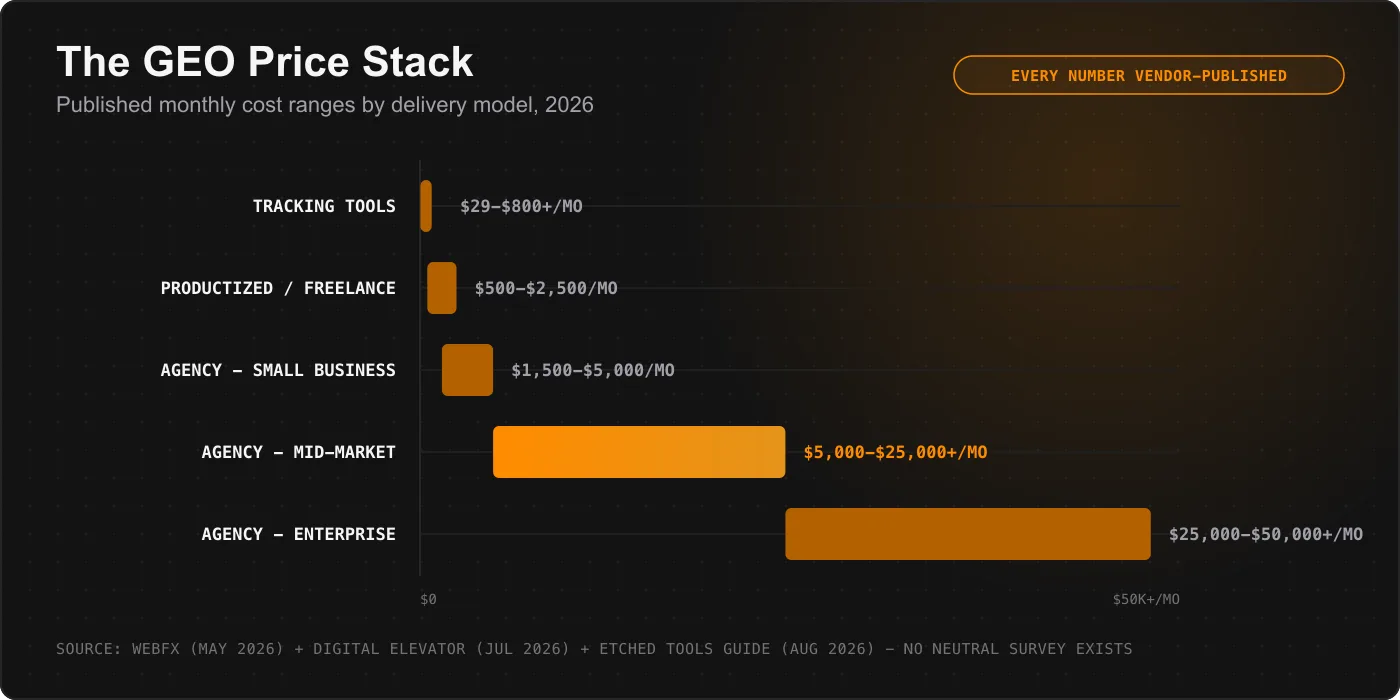
- Agency GEO retainers run $1,500 to $5,000 per month for small-business scopes, $5,000 to $25,000+ for mid-market, and $25,000 to $50,000+ for enterprise (WebFX, May 2026).
- There is no neutral survey of GEO pricing as of August 2026. Every published range comes from an agency or tool vendor, and most guides recycle each other's numbers.
- The mature-SEO baseline is real but dated: Ahrefs' poll of 439 providers averaged $2,917 per month, and it predates the GEO era entirely.
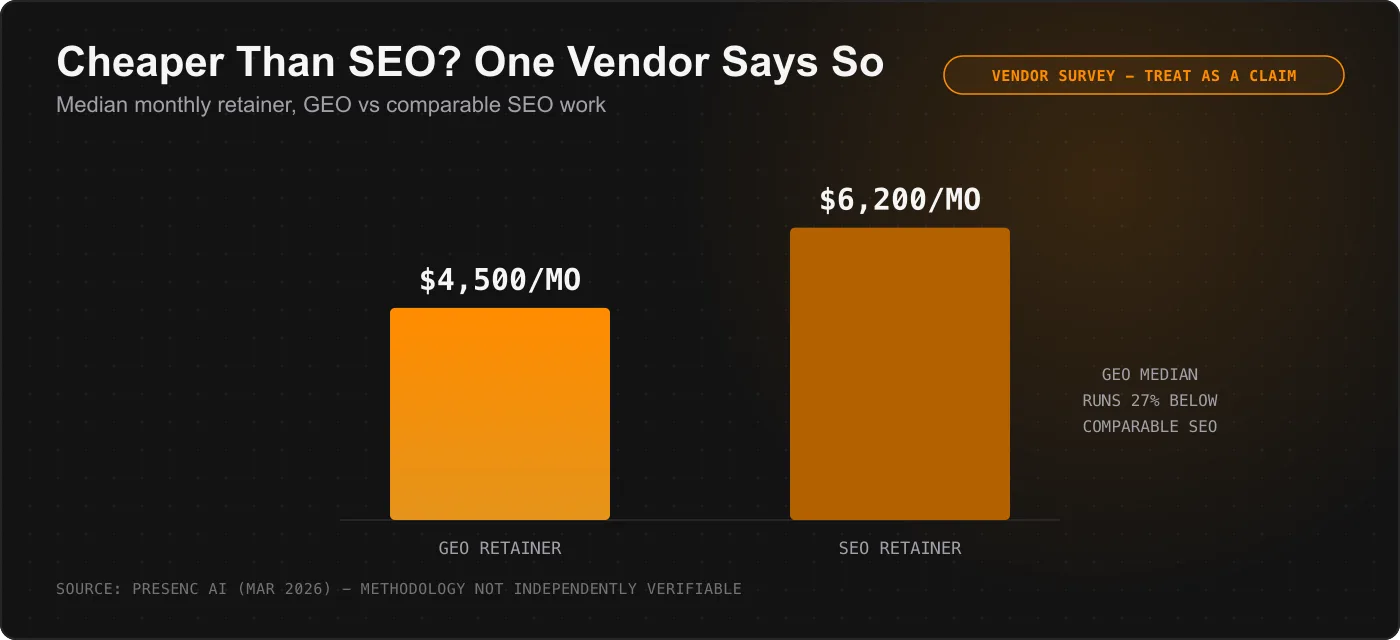
- One vendor survey claims GEO retainers actually price below comparable SEO work ($4,500 median vs $6,200). Treat it as a claim, not a fact; its methodology can't be independently checked.
- Judge any quote on deliverables, not adjectives: prompts tracked, engines covered, content shipped, and reporting cadence. A guaranteed "#1 in ChatGPT" is a red flag, not a feature.
Definition: GEO Pricing
GEO pricing is what it costs to measure and improve how AI engines like ChatGPT, Gemini, Claude, and Perplexity describe and recommend a brand. It splits into three distinct spends that get conflated in most guides: measurement tooling (software that tracks mentions), execution (the entity, content, and technical work that moves the number, bought as a retainer or staffed in-house), and one-time diagnosis (the audit that tells you where you stand and what to fix first).
Why is it so hard to get a straight answer on GEO pricing?
Because nobody neutral has measured the market yet. When we researched this question properly for our agency versus in-house comparison, the strongest finding was a negative one: as of August 2026 there is no independent, third-party survey of GEO agency pricing anywhere. Every cost guide you will find in a search result, and every number in an AI-generated answer about GEO pricing, traces back to an agency or a tool vendor. Many of the guides visibly recycle each other's ranges, which manufactures a false consensus: the same figure repeated by ten sellers is still one seller's figure.
That does not make the numbers useless. It means you should read them the way you would read a car dealer's market report: directionally informative, commercially motivated, and worth triangulating against anything independent you can find. The closest independent anchors are from the mature SEO market: Ahrefs polled 439 SEO providers and found an average retainer of $2,917 per month, with agencies at $3,209 (Ahrefs), and Credo's pricing survey put US SEO agencies at an average of $147.93 per hour (Credo). Both surveys predate the GEO era, so they are floors and reference points, not GEO prices.
What do the published agency ranges actually say?
With the sourcing caveat stated, the ranges are consistent enough to be useful. WebFX's cost guide, a widely cited benchmark, puts agency GEO at $1,500 to $5,000 per month for small-business scopes, $5,000 to $25,000+ for mid-market, and $25,000 to $50,000+ for enterprise (WebFX, May 2026). Below the agency tier, productized and freelance packages run roughly $500 to $2,500 per month (Digital Elevator, July 2026), with the disclosure that this guide partially derives its ranges from WebFX's, so the two are not independent of each other. One-time audits run roughly $3,000 to $15,000 in vendor guides (LLM Reach, June 2026).
The most interesting published claim cuts against the "AI premium" narrative. Presenc AI, a GEO tool vendor, ran the only thing resembling a pricing survey in this market and reports a median GEO retainer of $4,500 per month against $6,200 for comparable SEO work, with GEO tiers from $1,500 basic monitoring up to $12,000 to $25,000 enterprise (Presenc AI, March 2026). Its methodology cannot be independently checked, so treat the finding as a vendor's claim. But if even a seller's own data says GEO prices below SEO right now, the widely repeated line that "GEO costs more than SEO" deserves your skepticism too.
For a concrete anchor with no survey ambiguity at all: our own GEO Audit is $5,500 one-time, and retainers run $7,500, $15,000, and $25,000+ per month across three tiers. Those sit inside the published mid-market band, which is at least weak evidence the vendor ranges are directionally real.
What about tools, or doing it in-house?
The tool layer is the cheapest line item and the most commonly misunderstood one. Dedicated AI-visibility trackers run $29 to $800+ per month depending on tier, priced line by line in our tools and method guide. A tool is a thermometer: it tells you how often engines mention you and who gets named instead. It does not write the content, fix the entity problems, or earn the third-party mentions that actually move the reading. Budgeting the tool and skipping the work is the most common way to spend real money on GEO and change nothing.
In-house is the other end of the scale, and we priced it fully in the agency versus in-house piece: a senior hire capable of leading the program averages $114,766 in base salary, which lands around $143K to $161K fully loaded before tools, with a 44-day average hiring cycle and up to a year of ramp in a talent market that pays a 20.5% premium for AI-search skills. In year one, in-house is the most expensive option for almost everyone below enterprise scale. Its advantage is permanence, not price.
Key takeaway: Tools measure for $29 to $800+ per month but move nothing by themselves. In-house runs $143K+ per year fully loaded before tooling. The retainer band in between is where most mid-market buyers land, which is exactly why the sellers publish the guides.
How should you read a GEO price quote?
Anchor on deliverables, not adjectives. One agency's published tier mapping (Passionfruit, itself a GEO seller) is useful less for its dollar figures than for showing what each level should specify: entry tiers around $1,500 to $3,000 tracking 20 to 50 citation queries across 2 to 3 platforms, mid tiers adding more engines and 2 to 4 content pieces a month, premium tiers above $7,000 adding volume and strategy depth (Passionfruit, 2026). Whatever the price, the quote should answer the same questions:
| What to pin down | Why it matters |
|---|---|
| How many prompts are tracked, on which engines, how often | This is the measurement backbone; sample size decides whether the numbers mean anything |
| What ships each month (content, technical fixes, entity work) | The work, not the monitoring, is what moves visibility |
| What the report shows and against which competitors | Share of voice against named rivals beats a vanity "visibility score" |
| What happens at the end of the engagement | A playbook you keep, or a dependency you rent |
And one red flag outranks the rest: anyone guaranteeing a specific position, "#1 in ChatGPT" or a promised ranking, is selling something the data says cannot be promised. The same prompt returns the same list of brands less than 1 in 100 times (SparkToro, January 2026). Visibility rate across many prompts and runs is a real, buyable outcome. A guaranteed rank is not.
Key takeaway: Judge quotes on prompts tracked, engines covered, work shipped, and what you keep afterward. A guaranteed AI ranking is a red flag; the answers are too unstable for anyone to promise a position honestly.
Frequently Asked Questions
How much does GEO cost per month in 2026?
Published ranges: AI-visibility tools run $29 to $800+ per month, productized and freelance work runs roughly $500 to $2,500, and agency retainers run $1,500 to $5,000 for small-business scopes, $5,000 to $25,000+ for mid-market, and $25,000 to $50,000+ for enterprise. Every one of those numbers was published by a company selling GEO, because no neutral survey of the market exists yet.
Is GEO more expensive than SEO?
Unsettled. One tool vendor's survey claims GEO retainers currently price below comparable SEO work (a $4,500 median against $6,200), while several agency guides argue GEO runs slightly higher because of content restructuring. The market is too young for a reliable answer, and the mature-SEO baseline (Ahrefs' 439-provider poll averaging $2,917 per month) predates the GEO era entirely.
How much does a GEO audit cost?
Vendor guides put one-time GEO audits at roughly $3,000 to $15,000, with enterprise scopes higher. For a concrete number with no survey ambiguity: our own GEO Audit is $5,500, credited toward a retainer within 30 days.
Can I do GEO for just the cost of a tool?
A tool tells you the score; it does not change it. $29 to $800+ per month buys measurement: which engines name you, how often, and who gets named instead. The spend that moves the number is the work on entity clarity, content, and third-party presence, whether you buy that as a retainer or staff it in-house.
What should a GEO retainer include at each price level?
Anchor on deliverables, not adjectives: how many prompts are tracked, across how many engines, at what cadence, how much content ships per month, and what the report shows. Entry tiers (roughly $1,500 to $3,000) typically track a few dozen queries on 2 to 3 engines; mid tiers add more engines and monthly content; enterprise tiers add multi-market tracking and custom engineering.
How Etched prices GEO
Transparently, because this article would be hypocritical otherwise. The $5,500 GEO Audit is the front door: it produces your measured baseline across ChatGPT, Gemini, Claude, and Perplexity plus a prioritized fix list, and it is credited toward a retainer within 30 days. Retainers run $7,500, $15,000, and $25,000+ per month depending on scope, priced against the outcome we can measure: your share of the answers your buyers actually see, including the ones currently naming your competitor.
Not sure the problem justifies any of these numbers yet? Run the free AI visibility check first. If the engines already represent you well, save the budget.
Run the free AI visibility check


