
Generative Engine Optimization (GEO) for SaaS is the practice of making a B2B software product visible, accurately described, and recommended inside AI-generated answers from ChatGPT, Perplexity, Gemini, and Google's AI surfaces. It matters for one commercial reason: 51% of B2B software buyers now begin purchase research in an AI chatbot rather than a search engine, and the shortlist those tools produce decides most deals before a vendor ever hears about them.
Key Takeaways
- 51% of B2B software buyers now start research in an AI chatbot, up from 29% a year earlier (G2, April 2026).
- 69% of buyers chose a different vendor than they originally planned because of AI chatbot guidance, and 33% bought from a brand they'd never heard of before an AI suggested it.
- AI referral traffic converts at 4.4x to 23x the rate of organic search, but organic still drives far more absolute volume. The channels have decoupled: volume vs. value.
- Only 12% of the URLs AI engines cite overlap with Google's top 10 for the same prompt: your rankings do not predict your AI visibility.
- The playbook is evidence distribution: retrievable product facts, comparison pages, third-party reviews, and citable original data, measured by reference rate, not rank.
Definition: GEO for SaaS
GEO for SaaS is the discipline of increasing how often, and how accurately, AI answer engines mention, describe, and recommend a B2B software product when buyers ask for solutions. Unlike traditional SEO, the optimization target is a synthesized recommendation rather than a ranked URL: the engines assemble answers from your documentation, review-site profiles, comparison articles, and community discussions, and an unlinked brand mention can matter as much as a backlink.
Why are B2B software buyers starting in AI chatbots instead of Google?
Because the chatbot does the evaluation work for them. G2's April 2026 Answer Economy report found that 51% of B2B software buyers now start research in an AI chatbot more often than in Google, up from 29% just twelve months earlier, and 71% rely on chatbots somewhere in the research process (G2, April 2026). Forrester's survey of roughly 18,000 global buyers confirms the scale: 94% used AI in their buying process, up from 89% a year earlier, and generative AI now outranks vendor websites, product experts, and sales reps as the most meaningful information source (Forrester, January 2026).
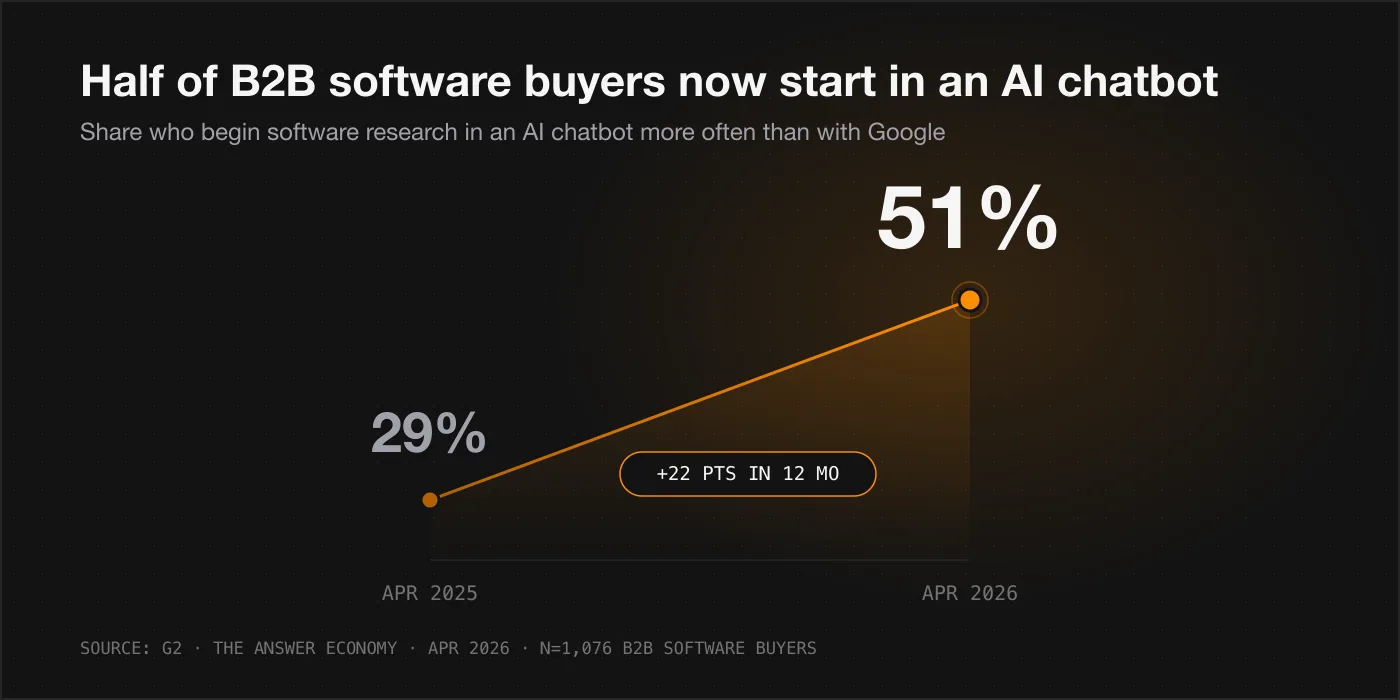
The revenue consequence is direct. 69% of buyers chose a different vendor than they originally planned because of AI chatbot guidance, and 33% purchased from a brand they had never heard of before an AI suggested it (G2 Learn, June 2026). Combine that with 6sense's finding that 95% of B2B purchases go to a vendor on the buyer's Day-One shortlist, and the pre-contact favorite wins roughly 80% of the time (6sense, 2025), and the conclusion is unavoidable: the AI conversation is the shortlist.
How do ChatGPT, Perplexity, and Gemini decide which SaaS products to recommend?
There is no single "LLM ranking algorithm." Each engine assembles recommendations from a different mix of training data and live retrieval:
| Engine | Documented sourcing behavior |
|---|---|
| ChatGPT / ChatGPT Search | Live web retrieval with inline citations; recommendations can draw on structured product metadata and third-party review summaries (OpenAI) |
| Google AI Overviews / AI Mode | "Query fan-out": multiple sub-searches per prompt; standard Google indexability requirements apply (Google) |
| Perplexity | Real-time web answer engine; every answer carries clickable source citations (Perplexity) |
| Gemini | Grounded in Google's search and retrieval infrastructure, sharing the fan-out mechanism (Google) |
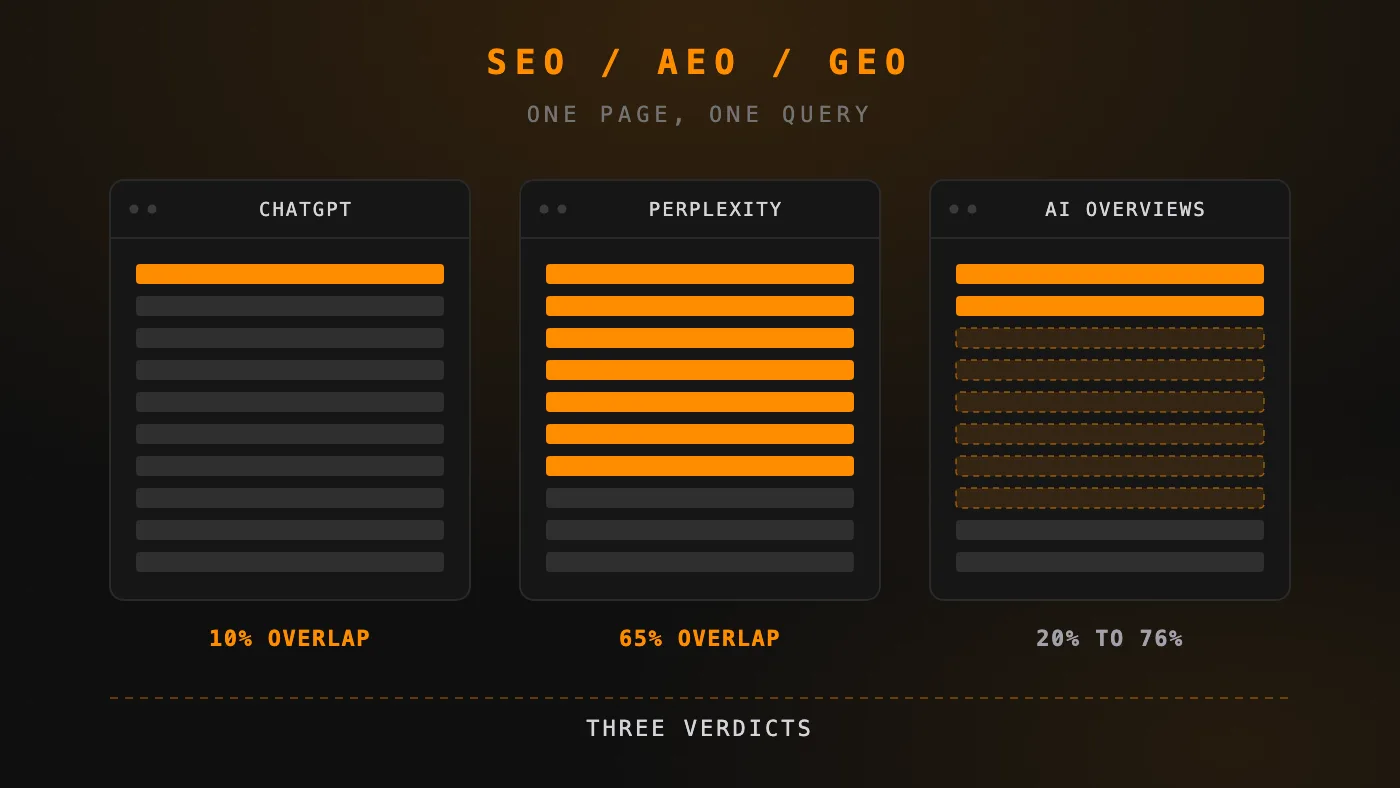
Two findings should reset how marketing leaders measure this. First, Ahrefs found only 12% of URLs cited by ChatGPT, Gemini, and Copilot also appear in Google's top 10 for the same prompt: your Google rankings do not predict your AI visibility (Ahrefs). Second, unlinked brand mentions correlate with AI Overview visibility at 0.664, versus 0.218 for backlinks, across a 75,000-brand analysis (Ahrefs). AI engines learn who you are from the entire evidence network: review marketplaces, comparison articles, Reddit threads, and your own documentation, which is why entity clarity and schema sit underneath everything else in a GEO program.
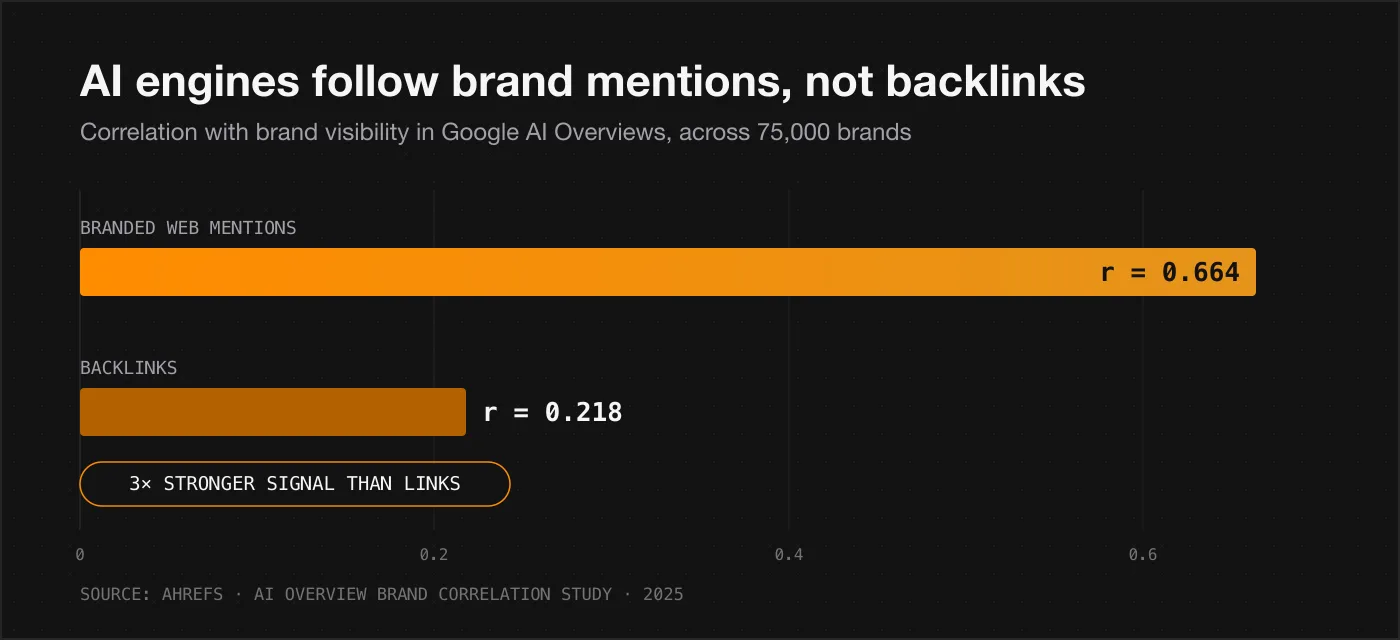
Key takeaway: Only 12% of AI citations overlap with Google's top 10 results. Brand mentions predict AI visibility three times better than backlinks. Rank tracking alone cannot measure AI recommendation share.
What is AI referral traffic worth compared to organic search?
Less volume, radically better buyers. The channels have decoupled:
| Metric | Organic search | AI referrals |
|---|---|---|
| Conversion rate | Baseline | 4.4x baseline (Semrush, 2025) |
| B2B SaaS ceiling case | The other 99.5% of Ahrefs sessions (all channels) | 0.5% of sessions, 12.1% of signups, a 23x differential (Ahrefs) |
| Volume trend | Clicks fall to 8% vs 15% when an AI summary appears (Pew, 2025) | 1.13B referrals in June 2025, up 357% YoY (Similarweb via TechCrunch) |
| Absolute lead volume | Still dominant: one 2026 analysis found organic generated 37x more leads than AI (PipeRocket) | Small base, compounding fast |
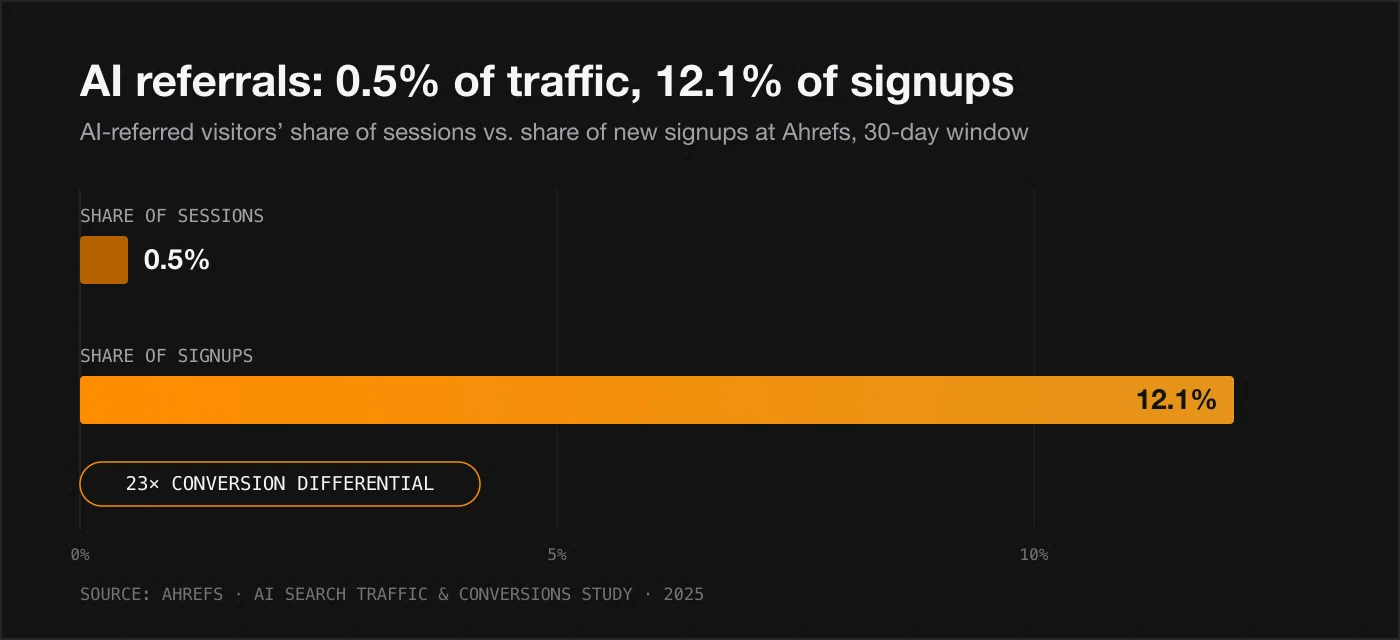
Gartner's forecast of a 25% decline in traditional search volume by 2026 (Gartner) frames the direction, but organic still pays most of the bills today. The bigger risk is having no presence at all in the channel where your most qualified buyers pre-decide. If you haven't measured that presence yet, start with how to measure brand visibility in AI search.
What does an effective GEO strategy for B2B SaaS include?
Five workstreams, in priority order:
- Make product facts retrievable. Explicit pricing, feature, integration, security, and migration pages: the raw material engines quote. This is where schema markup earns its keep.
- Publish comparison evidence. "X vs. Y," alternatives, and use-case pages map directly to how buyers prompt. Write content AI engines can actually quote, not generic top-of-funnel filler.
- Strengthen third-party corroboration. Review sites just edged past AI chatbots (38% vs 37%) for the first time as the top shortlist source (G2, July 2026), and they are what the chatbots themselves cite.
- Create citation-worthy original data. Princeton's foundational GEO research measured visibility gains up to 40% from adding statistics, quotations, and citations (Princeton).
- Measure reference rate, not rank. a16z frames the new KPI as whether your brand is selected into generated answers (a16z); track it as AI share of voice against your named competitors, across a stable panel of buyer-realistic prompts.
Which GEO tactics do not work?
llms.txt does not currently move recommendations. Ahrefs found 97% of llms.txt files received zero traffic of any kind in May 2026 (Ahrefs), and a Search Engine Land ten-site test found no attributable lift (SEL). We've published a full assessment of llms.txt: ship it, but don't budget around it.
Paid mentions are a liability. The Wall Street Journal documented businesses paying for favorable chatbot mentions (WSJ, 2026), and adversarial research shows manipulated content can push flawed products into top-3 recommendation sets, a gap that current defenses only partially close, per the paper's own tests (SafeGEO, arXiv). Rand Fishkin's caution completes the picture: SparkToro's research with Gumshoe.ai found the same prompt returns different brand recommendations run to run, AI "rankings" are mostly noise, and only visibility percentage across many prompts and runs is a stable metric (SparkToro). Mention share, in other words, is not revenue.
Key takeaway: llms.txt files show no measurable effect on AI recommendations. Paid or manufactured mentions create manipulation risk without proven pipeline return.
Frequently Asked Questions
What is Generative Engine Optimization (GEO) for SaaS?
GEO for SaaS is the practice of increasing how often and how accurately AI engines like ChatGPT, Perplexity, and Gemini mention, describe, and recommend your software product in generated answers. The optimization target is a synthesized recommendation, not a ranked URL.
Is GEO different from traditional SEO?
GEO builds on SEO but targets a different output: a synthesized recommendation instead of a ranked URL. Only 12% of AI citations overlap with Google's top 10 for the same prompt, so each requires its own measurement. Crawlability, schema, and content quality remain the shared foundation.
Which sources most influence AI recommendations of B2B software?
Review marketplaces (G2, Capterra, TrustRadius), independent comparison articles, community discussions on Reddit, and the vendor's own documentation collectively shape AI answers. No single source controls the outcome: engines assemble recommendations from the whole evidence network.
How should a CMO measure GEO performance?
Track recommendation rate across a stable panel of buyer-realistic prompts, competitive share of voice, factual accuracy of AI descriptions, and conversion of AI-referred traffic, not one-off chatbot rankings, which vary run to run.
Does AI referral traffic actually convert for SaaS?
Yes, at 4.4x the rate of organic search on average (Semrush), and up to 23x in documented B2B SaaS cases (Ahrefs). The volume is still small relative to organic, but visitors arrive pre-qualified because the AI has already compared alternatives for them.
How Etched runs GEO for SaaS brands
The buyers have moved; the measurement has to follow. We build GEO programs for B2B SaaS on the evidence-distribution model this article describes: entity clarity and schema underneath, citable content and third-party corroboration on top, all measured as AI share of voice against the competitors AI actually recommends instead of you.
Want to know whether ChatGPT recommends you or your competitor? Run the free AI visibility check for an immediate automated snapshot, or review the human-led SEO/AEO Core Audit for a focused competitive baseline.
Run the free AI visibility check
Related Services
Last updated: October 21, 2026