

When a buyer asks ChatGPT "who's the best [category] for [problem]?", they get a shortlist of names, not ten blue links. AI share of voice is the percentage of those AI answers, across the questions your buyers actually ask, in which your brand is the one recommended. It's the closest thing there is to a scoreboard for whether generative engines are sending you business.
Keyword rank measures a page your buyer increasingly never sees. AI share of voice measures the outcome that replaced it: getting named. If you measure your visibility in AI search at all, this is the number to put at the top of the report.
Key Takeaways
- AI share of voice = the share of relevant AI answers that recommend your brand versus competitors.
- It's a portfolio metric: measured across a set of real buyer prompts and across ChatGPT, Gemini, Claude, and Perplexity, not a single query.
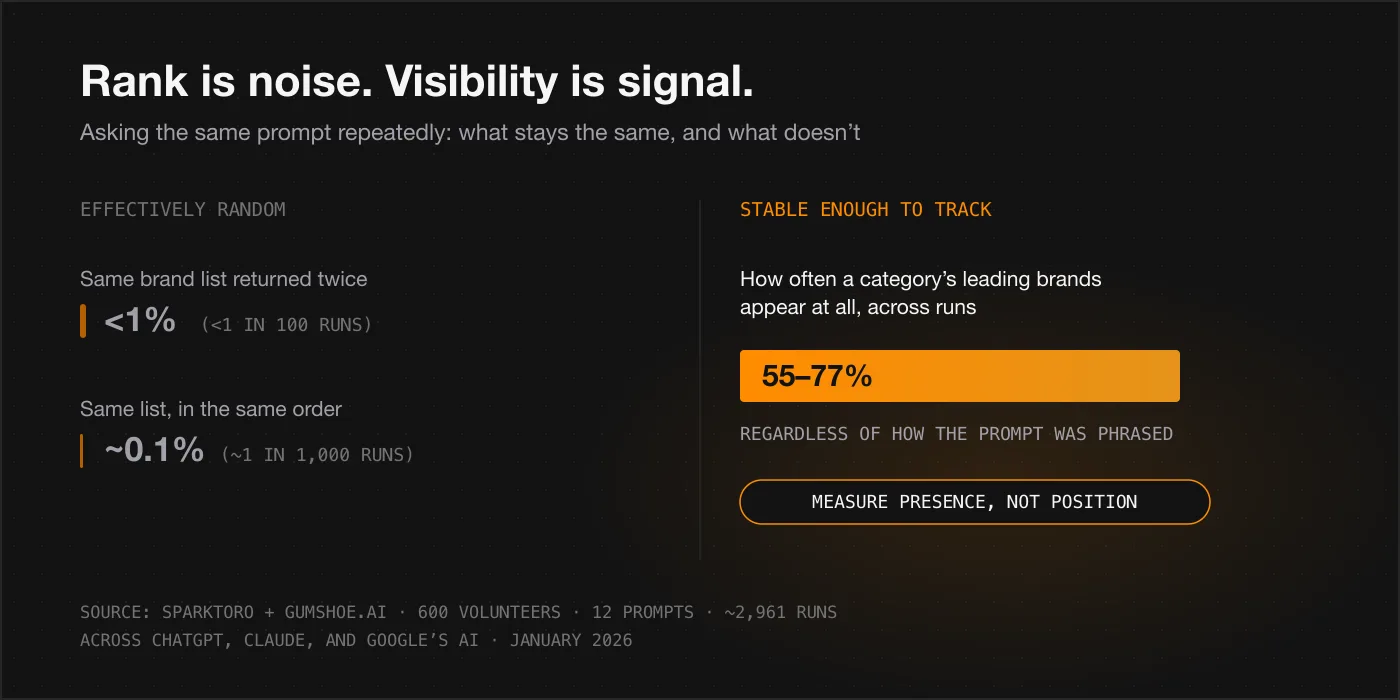
- Ask the same prompt twice and you will almost certainly get a different list: under a 1-in-100 chance of an identical set of brands, per SparkToro and Gumshoe.ai.
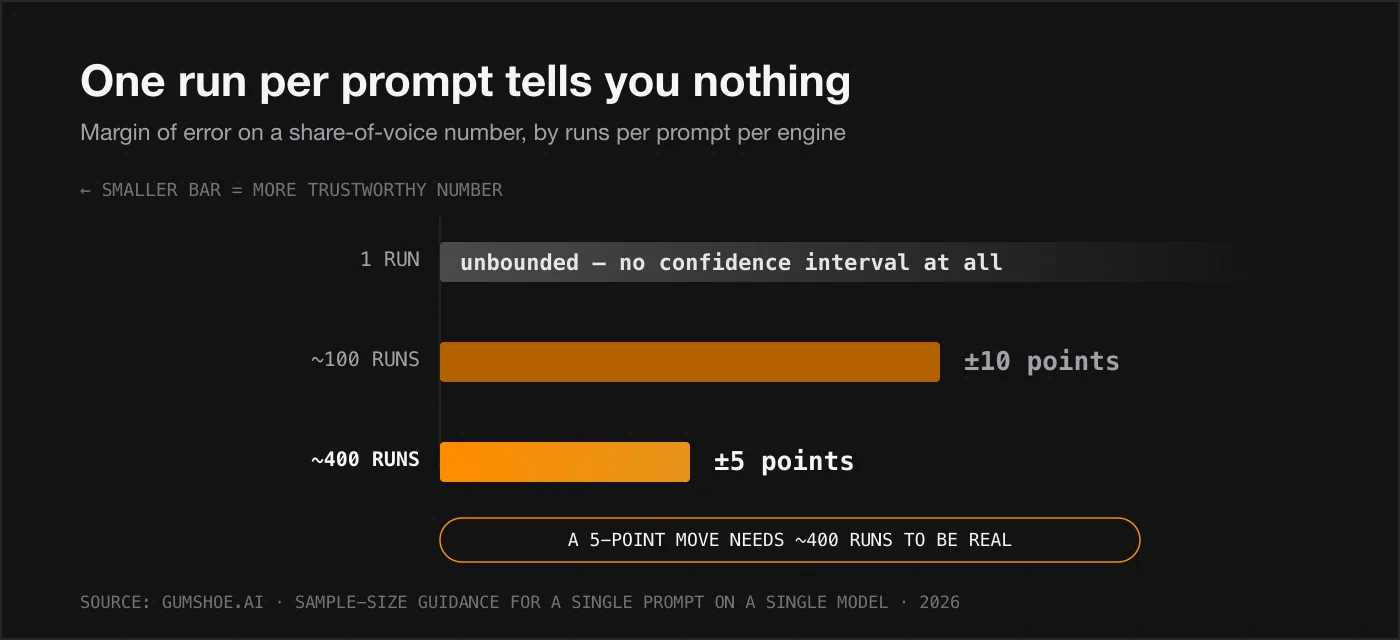
- Sample properly or the number is noise: roughly 100 runs per prompt per engine for +/-10 points, 400 for +/-5.
- Unlike keyword rank, it captures the outcome buyers act on: being named in the answer.
- Track presence, position, and sentiment together: being mentioned last or negatively is not the same as being recommended first.
Definition: AI Share of Voice
AI share of voice is the percentage of AI-generated answers: across a defined set of buyer questions and across engines like ChatGPT, Gemini, Claude, and Perplexity: in which a brand is mentioned or recommended, measured relative to its competitors. It quantifies how often AI engines put you in the answer versus someone else.
Why keyword rankings stopped telling the whole story
For twenty years, "where do I rank?" was a fair proxy for "am I getting found?" A #1 organic result earned the clicks, so rank and demand moved together.
That link is breaking. A growing share of buyer research now ends in an answer, not a results page: the engine reads the sources and hands back a recommendation. Your #1 keyword ranking and your absence from the AI answer for that same query can be true at the exact same time, and only one of them reflects where the buyer's attention went.
- Rank measures a page; share of voice measures the outcome. Being on the page is worth less when the buyer never opens it.
- Rank is single-query; buyers ask in dozens of phrasings. Share of voice aggregates across the real question set.
- Rank ignores your competitors' presence. Share of voice is relative by definition: it tells you not just whether you showed up, but whether you beat the field.
How to calculate AI share of voice
Share of voice is a portfolio metric, not a single lookup. The method is straightforward:
1. Build your buyer question set
List the 15-30 questions your buyers actually ask when they're choosing: "best [category] for [use case]", "[competitor] alternatives", "is [your brand] any good?", "how do I solve [problem]?". This prompt set is the foundation; a share-of-voice number is only as honest as the questions behind it.
2. Run each question many times, on every engine
This is the step most share-of-voice reporting gets wrong, and it's the difference between a number you can act on and a number that's mostly noise.
Ask the same question once and you've sampled a random draw. SparkToro and Gumshoe.ai had 600 volunteers run 12 identical prompts roughly 2,961 times across ChatGPT, Claude, and Google's AI, and found less than a 1-in-100 chance of getting the same list of brands twice, and closer to 1 in 1,000 of getting that list in the same order (SparkToro). As Rand Fishkin put it: "If you ask an AI tool for brand/product recommendations a hundred times nearly every response will be unique."
What survived that scrutiny is the thing this metric is built on. Brands that belonged in a category appeared in 55-77% of responses regardless of how the prompt was phrased. Position is random; presence is stable.
So sample properly. Gumshoe's guidance for a single prompt on a single model is about 100 runs to land within +/-10 percentage points, and about 400 for +/-5 (Gumshoe.ai). Below that, you cannot tell a real improvement from resampling noise, which matters enormously when you're about to report a quarter's progress.
Run the set on ChatGPT, Gemini, Claude, and Perplexity, and record who gets named in each response, including your competitors. Track each engine separately as well as combined, and know what actually differs between them. BrightEdge found that any two engines' top-100 cited sources overlap by just 16-59%, while the brands they name overlap by 36-55% (BrightEdge). Engines disagree far more about which pages to quote than about which companies to recommend.
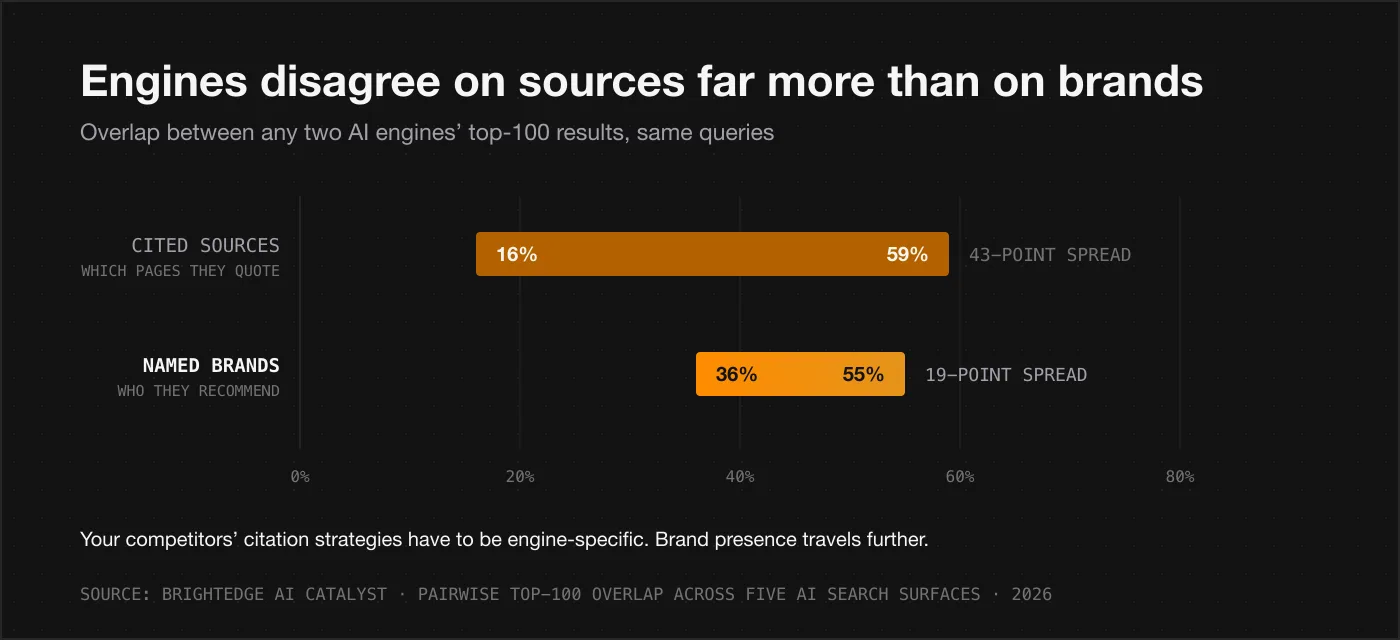
That asymmetry has a practical consequence: the citation work that earns you a mention has to be engine-specific, but once you're in a category's consideration set, that presence travels better than any single source does.
3. Score three things, not one
For every answer, capture:
- Presence: are you mentioned at all?
- Position: are you recommended first, or listed fourth as an afterthought?
- Sentiment, is the mention positive, neutral, or a caveat?
4. Calculate the share
At its simplest, AI share of voice is your mentions divided by total brand mentions across all answers:
AI share of voice = (answers that mention your brand) / (total relevant answers) x 100
A weighted version (counting first-position, positive recommendations more heavily than a passing mention) is more useful, because "recommended first" and "named last with a caveat" are not the same result.
Presence, position, and sentiment: why one number isn't enough
A brand can have "40% share of voice" and still be losing, if most of those mentions are fourth-place afterthoughts or come with a "but their support is slow." Treat share of voice as three linked measures:
| Signal | Question it answers | Why it matters |
|---|---|---|
| Presence | Do they mention me at all? | The floor: you can't win an answer you're absent from. |
| Position | Am I recommended first, or listed last? | First-named brands capture the intent. |
| Sentiment | Is the mention positive, neutral, or hedged? | A negative mention can be worse than silence. |
Move all three up and to the right and you become the brand the answer recommends.
What good looks like
There's no universal benchmark, because share of voice is always relative to your specific competitive set and question list. The one external reference point worth holding onto comes from the SparkToro/Gumshoe data: brands the engines genuinely associate with a category showed up in 55-77% of responses. If you're in single digits for questions you should own, you're not in the consideration set at all: you're an occasional draw.
Beyond that, the useful reference points are internal:
- Your baseline today, measured before you change anything.
- Your trend: share of voice moving up quarter over quarter is the signal that your GEO work is compounding.
- Your gap to the leader: if one competitor owns 60% of the answers in your category, that's the ceiling you're closing on, and the clearest picture of the opportunity.
The goal isn't a magic percentage. It's to be measurably more recommended this quarter than last, and to be closing the gap on whoever the engines currently trust most.
Do you need a tool for this?
Do the arithmetic on the method above and the answer becomes obvious. A 25-prompt set, across four engines, at 100 runs each, is 10,000 queries per measurement cycle, and a trend line needs that repeated every month. Manual measurement is fine for a one-off spot check and impossible as a program.
A category of AI visibility tools now automates it. They fall into three groups, and the distinction matters more than any brand name:
| Type of tool | What it does | What it doesn't do |
|---|---|---|
| AI-visibility monitors | Run prompt panels on a schedule, track presence, position, sentiment, and cited sources | Decide which prompts matter, or fix what they find |
| Search platforms with AI modules | Add AI-answer tracking to existing rank, keyword, and backlink data | Separate AI performance from the rest of the reporting picture |
| Agency reporting platforms | Roll AI visibility into per-client dashboards alongside paid and organic channels | Replace the analysis of why a competitor owns your category |
Whichever you use, the prompt set stays yours: the number is only ever as accurate as the questions behind it, and no tool knows your buyers' language better than you do. So does the work that moves the number. A tool is a thermometer; it will tell you that you're at 12% and your competitor is at 61%, and it will not tell you that the reason is a thin entity footprint and no third-party citations.
How to move it
Share of voice is a lagging indicator: it moves when the underlying signals do. The levers are the same ones that make a brand legible and quotable to AI in the first place:
- Entity clarity so engines confidently know what you are and can recommend you without hedging.
- Schema and structured data so your facts are machine-readable and unambiguous.
- Citable content so there's something clear and self-contained for an engine to quote.
- Third-party citations: being referenced by sources the engines already trust, since AI recommends what credible others reference.
Pull those levers, re-measure the same prompt set on the same engines, and watch the share move. That closed loop (measure, fix, re-measure) is the whole discipline.
AI share of voice vs. keyword rankings
| Keyword rankings measure... | AI share of voice measures... |
|---|---|
| Position on a results page | Presence in the actual answer |
| A single query at a time | A portfolio of real buyer questions |
| One search engine (Google) | ChatGPT, Gemini, Claude, and Perplexity together |
| Your page in isolation | Your standing relative to competitors |
| Clicks earned | Recommendations earned |
Rankings aren't worthless: they still describe part of the picture. But when a buyer's journey ends in an answer, the metric that predicts revenue is the one that tells you whether you were in it.
Frequently Asked Questions
What is a good AI share of voice score?
There's no universal benchmark, because the number is always relative to your competitive set and your specific buyer questions. One external reference point: SparkToro and Gumshoe.ai found that brands genuinely associated with a category appear in 55-77% of AI responses. Below that, the meaningful comparisons are internal: your baseline, your trend, and your gap to the category leader.
How many times do I need to run each prompt?
Many more than once. AI answers vary run to run: SparkToro and Gumshoe.ai found under a 1-in-100 chance of the same brand list appearing twice for an identical prompt. Gumshoe puts the sample size at roughly 100 runs per prompt per model for +/-10 percentage points, and about 400 for +/-5. A single run per prompt produces a number you cannot distinguish from noise.
Should I track ranking position in AI answers?
Not as a primary metric. The same research that validates visibility tracking found ordering is close to random: roughly a 1-in-1,000 chance of the same list appearing in the same order across runs. Presence across many runs is stable and worth tracking; exact position is mostly noise.
How is AI share of voice different from traditional share of voice?
Traditional share of voice measures your presence in advertising or search results relative to competitors. AI share of voice measures how often generative engines actually recommend you in their answers (across ChatGPT, Gemini, Claude, and Perplexity) when buyers ask. It captures being named in the answer, not just appearing on a page.
Which AI engines should I measure?
At minimum ChatGPT, Gemini, Claude, and Perplexity, because buyers use different ones and the engines behave differently. BrightEdge found any two engines overlap on just 16-59% of cited sources and 36-55% of named brands, so track each engine separately as well as combined.
How often should I measure AI share of voice?
Monthly is a practical cadence for tracking a trend, with a deeper quarterly review tied to the GEO work you're shipping. AI answers shift as models update and as you improve your entity, schema, and content signals, so a point-in-time snapshot ages quickly: the value is in the trend line.
Can I improve my AI share of voice?
Yes. Share of voice is a lagging indicator of legibility and trust. Improving your entity clarity, structured data, citable content, and third-party citations gives engines more reason to recommend you. Re-measure the same questions on the same engines after those changes and the share moves: that measure-fix-re-measure loop is the core of GEO.
How Etched tracks and grows share of voice
We treat AI share of voice as the headline number of a GEO program: baseline it across your real buyer questions and every major engine, sampled deeply enough to survive the variance described above, then broken down by presence, position, and sentiment and reported as a trend against your competitors, not a vanity snapshot. Then we move it by fixing the entity, schema, and content signals underneath, and measure again.
The reporting runs on Trafiq. Most AI-visibility tools treat AI as its own island; Trafiq puts share of voice in a single white-label client dashboard next to that client's SEO, Google Ads, and Meta Ads performance, because "we're up 9 points in ChatGPT" only means something next to what the rest of the channel mix did in the same period. If you run an agency or manage a client roster, that's the view you're probably assembling by hand today.
Curious where you stand right now? Run the free AI visibility check for an immediate, automated snapshot. For human-led competitive analysis and an implementation roadmap, review the $5,500 GEO Audit.
Run the free AI visibility check
Related Services
Last updated: July 28, 2026


