

In FCA-commissioned research published in July 2026, 17% of UK consumers who had shopped for a financial product in the previous year used AI to help, and most of them then checked its answer against the provider or another source. AI has become a research layer in UK financial shopping, which makes it worth appearing in and worth measuring. Whether it decides who wins is a separate question, and the primary evidence for that is not there yet.
Key Takeaways
- 17% of UK consumers who shopped for a financial product in the last 12 months used AI to help, rising to 23% among people who already use AI.
- Between 62% and 80% of those users compared the AI answer against the provider or another source. Only 14% to 25% followed it.
- The most common use was summarizing and explaining (72%), not being told what to do.
- UK rules already apply to AI-surfaced promotions. The FCA said in February 2026 it does not plan to add AI-specific regulations.
- The widely quoted 25% search decline is a Gartner forecast about query volume, not a measurement of website traffic.
Are people using AI to shop for financial products?
Some are. The most directly relevant research is a study Yonder Consulting carried out for the Financial Conduct Authority, published on 6 July 2026 as part of the Mills Review. Among UK adults who had shopped for, taken out or switched a financial product in the previous 12 months, 17% used AI to assist them. Among people who already use AI in any part of their life, it was 23%.
Read the denominator carefully, because it is where this number usually gets inflated. It is not 17% of all adults. It is 17% of the 69% who shopped for something financial that year. The survey ran online in April 2026 with 5,026 UK adults holding a day-to-day bank account, quota-sampled and self-reported.
Two limits matter before anyone builds a forecast on it. This is UK data, and I found no US study using a comparable denominator. There is also no second wave, so the direction of travel is unknown. Anyone telling you AI use in financial shopping is growing at some particular rate is not reading this dataset, because this dataset cannot answer that question.
Definition: Generative Engine Optimization (GEO)
The practice of making a brand accurately described and consistently surfaced inside AI assistant answers, rather than inside a ranked list of links. For regulated firms it also covers whether the description an assistant produces is one the firm could stand behind.
What do they use it for?
Not for being told what to buy. The FCA research asked the 630 people who both shopped and used AI what they used it for, and the answers cluster around comprehension.
| What the consumer used AI for | Share of AI users who shopped |
|---|---|
| Summarize, explain or simplify information | 72% |
| Suggest what they should do | 58% |
| Upload personal data or documents, such as bank statements | 20% |
| Give AI ongoing access to accounts or software | 9% |
Respondents could pick more than one, so these do not sum to a whole. The gap between the first row and the last is the useful part. Letting an assistant explain a product is common; granting it account access is rare.
The research deck's annotation on the category breakdown notes that debt advice, investing and pensions are areas where consumers often seek some form of expert guidance. AI use clusters in those advice-shaped categories and thins out in commodity insurance lines.
Does the AI's answer decide anything?
This is where fintech separates from SaaS and DTC. In consumer goods, the assistant sits closer to the point of purchase. In financial products this data puts it further away.
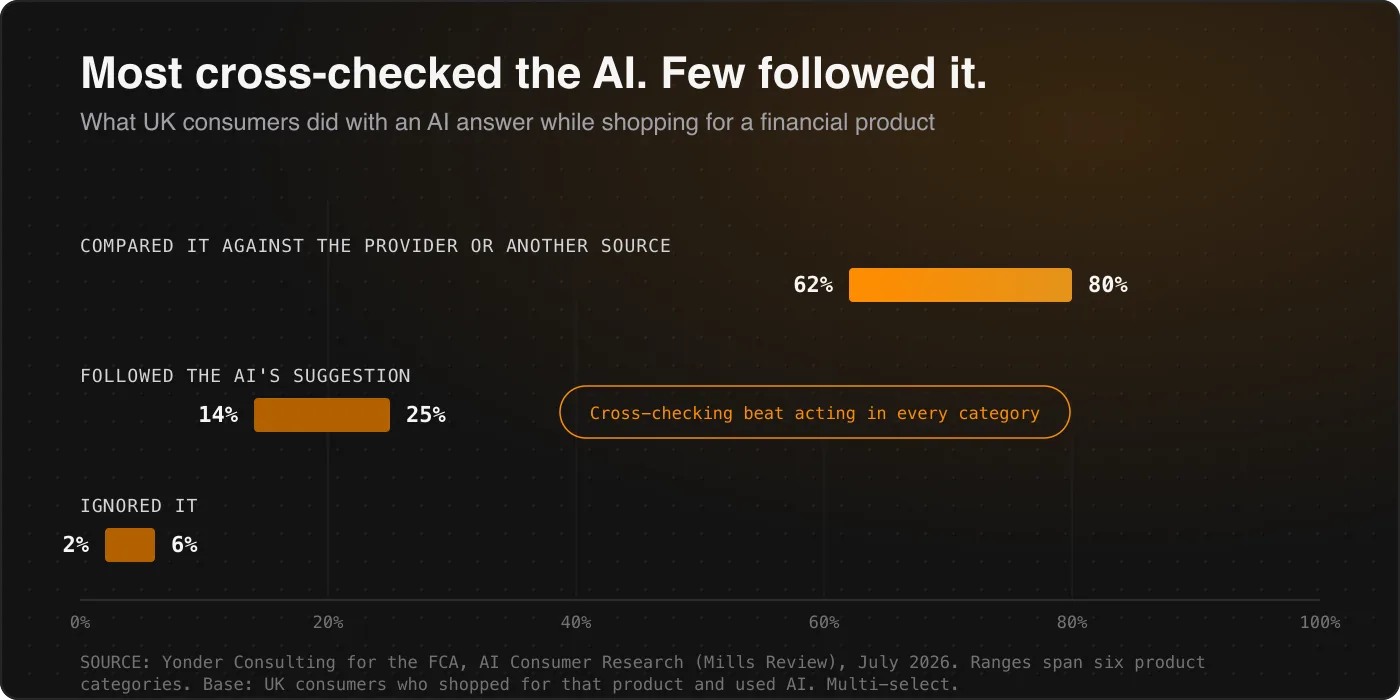
Across six product categories, between 62% and 80% of AI users compared the answer with the provider or another source. Between 14% and 25% followed the suggestion. The ranges span current accounts, savings, home and vehicle insurance, investing and credit cards. The deck does not publish per-product bases.
Key takeaway: In every product category measured, more UK consumers cross-checked the AI's financial advice than acted on it.
That does not make the visibility question irrelevant. If an assistant compresses six providers into two before anyone opens a comparison tab, being absent from the compression costs you the chance to be checked at all. It does mean the defensible claim is about consideration; the conversion case is not in this data.
What the UK rules require
UK financial promotions rules already cover this, and the FCA has said so plainly. Its published position, on a page last updated in February 2026, is that it does not plan to introduce extra regulations for AI. The framework is technology neutral, so an AI-surfaced snippet of your marketing is a financial promotion like any other. No US regulator position is described here; this section is UK only.
Which rulebook binds you depends on what kind of firm you are, and it is easy to cite the wrong one.
| Firm type | FCA Handbook provision | Standard |
|---|---|---|
| Investment platforms, wealth apps | COBS 4.2.1R | "fair, clear and not misleading" |
| Consumer credit and BNPL lenders | CONC 3.3.1R | "clear, fair, and not misleading" |
| Banks, deposit-takers, neobanks, payments and e-money firms | BCOBS 2.2.1R | take reasonable steps to ensure the same |
| Any retail customer communication | PRIN 2A.5.3R, Consumer Duty | "clear, fair and not misleading" |
If you want one provision that plausibly reaches every retail fintech communication, it is PRIN 2A.5.3R under the Consumer Duty, not COBS 4.2.1R. COBS is confined to designated investment business and long-term insurance, which excludes most payments, e-money and BNPL firms. Payments and e-money promotions fall under BCOBS 2.2.1R.
The practical consequence for GEO is specific. An assistant lifts a sentence out of your page and shows it without the risk warning that sat beneath it. The rules were already written for that situation, because a promotion has to be standalone compliant. What changes is that the fragment is now chosen by a system you do not control, so the compliance review has to happen at the sentence level.
There is no FG-series worked guidance for AI in the way FG24/1 provided one for social media. The FCA published an AI Update in 2024 explaining how existing rules apply, but it is not channel-specific promotions guidance. The FCA left that out on purpose: in its view the existing rules already cover the channel.
The AI platforms have their own rules for finance
If your fintech is building a product on top of a model, a second layer applies. Anthropic's usage policy, effective September 2025, names Finance as a High-Risk Use Case, requiring that a qualified professional review the content before it goes out and that you disclose AI use at the start of every session. OpenAI's policies put "financial activities and credit" among 13 areas where automating high-stakes decisions without human review is prohibited.
Both bind the companies deploying those models. Neither constrains what an assistant says to a consumer inside ChatGPT or Claude. The distinction matters because it is frequently collapsed, and the widely repeated claim that OpenAI banned financial advice misreads the document.
The 25% forecast, and what it measured
A slide claiming search volume is about to fall 25% will reach you sooner or later. That forecast is real, published by Gartner in February 2024. It is also about query volume rather than website traffic, and a Gartner analyst subsequently said the firm does not calculate search volume. Search Engine Land's coverage swapped volume for traffic in its headline and body.
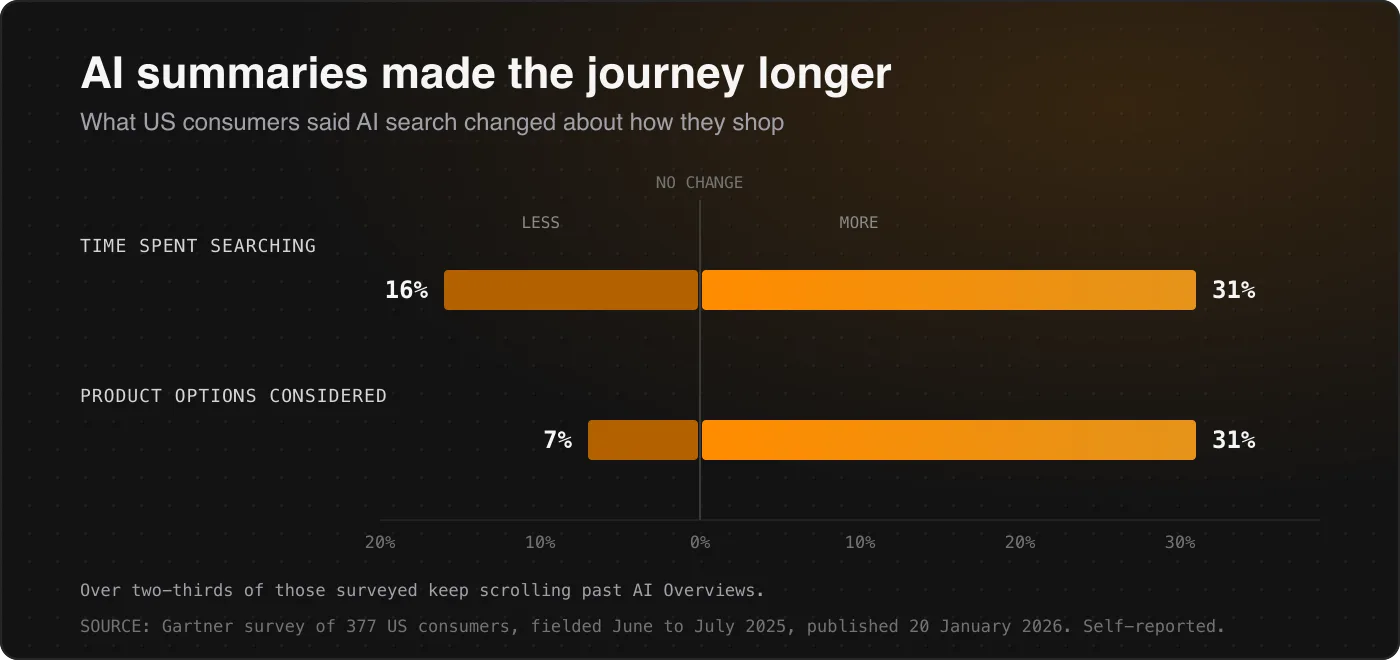
Gartner's more recent survey of US consumers measured something different: not query volume, but what people do. Asked in 2025 about AI summaries, 31% said they now spend more time searching and 16% less. On product options, 31% said they consider more and 7% fewer.
Key takeaway: The most-cited statistic in AI search marketing is a forecast about query volume, not a measurement of lost traffic.
What to do about it
The tactics are the same ones that work in other verticals, and the evidence for all of them is weaker than vendors imply. The best-known academic work on generative engine optimization found that its recommended techniques helped sources ranked low in search results, and that when every source on a page was optimized at once, the source already ranked first lost visibility. Those rank-by-rank results come from a GPT-3.5-era model against the authors' own simulated engine, though they tested on Perplexity separately.
So the program is unglamorous. Make your product facts unambiguous and consistent wherever they appear, on your own site and on the comparison and review sources assistants draw from. Keep your entity data and schema accurate so the assistant has something correct to lift. Write claims that survive being quoted alone, which your compliance function will recognize as an obligation you already had. Then measure which engines mention you and how they describe you, because share of voice in AI answers is the part of this you can observe most directly.
Where fintech differs is the review stage. A snippet that would be unremarkable for a SaaS brand may need a risk warning attached. That constraint belongs in the drafting, before any review sees the copy.
How Etched works with fintech brands
We start by measuring what the engines currently say about you across a large prompt sample, because the reason an assistant recommends a competitor is usually visible in that data. From there the work is entity clarity, evidence, and content that stays compliant when it is quoted out of context. Our focused SEO/AEO Core Audit is $2,500 one-time, credited to the first Core invoice if work starts within 30 days of audit delivery, and what that costs against alternatives is published rather than quoted on request.
You can also run the free AI visibility check to see which engines name you today.
Frequently Asked Questions
Do consumers use AI to choose financial products?
Some do, but the numbers are modest. In FCA-commissioned research published in July 2026, 17% of UK consumers who had shopped for, taken out or switched a financial product in the previous 12 months used AI to help. Among people who already use AI at all, it was 23%. That is UK data from an April 2026 panel, and there is no second wave yet, so the direction of travel is unknown.
Does AI actually decide which financial product people buy?
The available evidence says no. In the same FCA research, between 62% and 80% of people who used AI while shopping then compared its answer against the provider or another source. Only 14% to 25% followed the suggestion. AI is working as a research layer in financial shopping; the decision still happens elsewhere.
Are AI-generated financial promotions regulated in the UK?
Yes. The FCA said in February 2026 that it does not plan to introduce extra regulations for AI, because the existing rules are technology neutral and already apply. For most retail fintech communications the reaching provision is PRIN 2A.5.3R under the Consumer Duty, and firm type decides which sourcebook applies on top: COBS for investment business, CONC for consumer credit, BCOBS for deposit-takers.
What does GEO involve for a regulated financial brand?
The same entity and evidence work as any other vertical, with one extra constraint: an assistant can surface a fragment of your page without the surrounding context, so each claim needs to stand on its own. Practically that means clear product facts, consistent naming across your site and third-party sources, and monitoring which engines describe you correctly.
Is the 25% search decline statistic real?
It is a real Gartner forecast from February 2024, and it is routinely misquoted. The prediction was a 25% drop in search engine volume by 2026, not in website traffic, and a Gartner analyst later said the firm does not calculate search volume. Treat it as an analyst forecast about queries, not a measurement of traffic loss.
Related Services
Last updated: October 21, 2026


