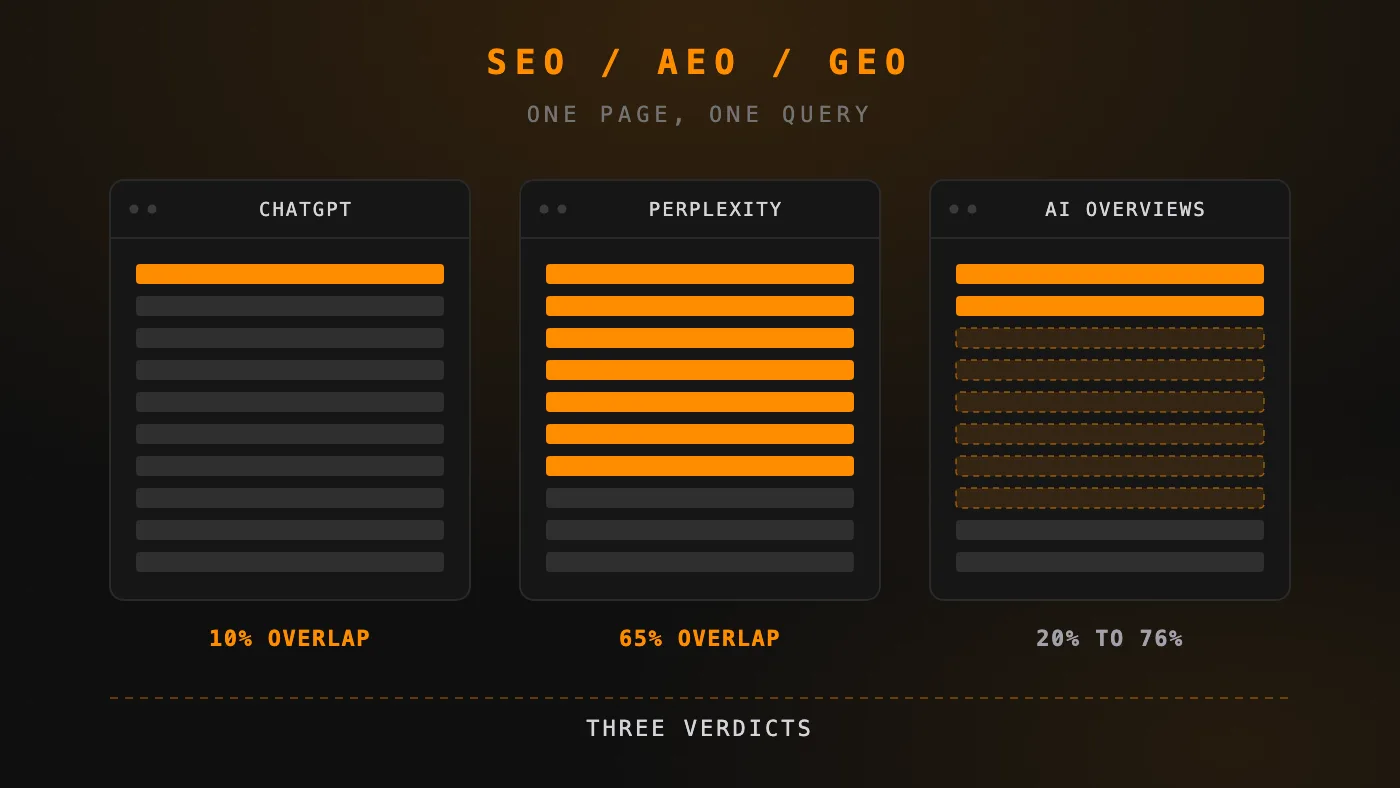

Generative Engine Optimization (GEO) is the work of measuring and improving how a brand appears in AI-generated answers. That includes whether the brand is described accurately, recommended for relevant needs, and linked as a source. These are separate outcomes.
The term covers a mixture of measurement, technical access, factual consistency, content, and supporting evidence. It does not identify a single ranking algorithm or a guaranteed route to inclusion.
Training and retrieval are different
Training shapes a model before a conversation. Publishing a new page does not directly update that process. Search-enabled assistants can retrieve current information at answer time, then use it in a generated response.
OpenAI's search documentation describes current web content, citations, query rewriting, and site-access conditions. Google's AI features documentation describes related searches and retrieval through query fan-out. The products do not all work the same way.
A brand absent from older training material is not automatically excluded from search-enabled answers. Conversely, appearing in training data does not guarantee a recommendation for a specific buyer.
How GEO overlaps with SEO
| Question | Shared foundations | Additional observation |
|---|---|---|
| Can the page be found? | Crawl access, indexing where applicable, internal links | Which product surface retrieved or cited it? |
| Are the facts useful? | Accurate, readable, relevant content | Did the answer repeat the facts correctly? |
| Does the business fit the need? | Clear product and audience information | Was the brand positively recommended? |
| Did the work help? | Tracked changes and business outcomes | Repeated answers under comparable conditions |
Google says no special schema or extra AI text file is needed to appear in its AI search features. Valid structured data may still support normal search uses. It should not be sold as a universal citation requirement.
What a useful program delivers
- A defined panel of real buyer questions, with the engines, markets, collection surfaces, and repetitions specified.
- Saved answers and sources, with mention, recommendation, and citation counts kept separate.
- A register of factual, access, and content gaps supported by that evidence.
- Agreed changes to pages, templates, company facts, and supporting material.
- A change log and a repeat measurement, with limitations and alternative explanations disclosed.
A cited source can suggest where to investigate. It does not reveal all internal reasons behind an assistant's answer. Likewise, a correlation between a brand signal and visibility does not establish that changing that signal will cause more recommendations.
How to read an AI visibility result
Ask for the denominator. A 20% mention rate might mean 20 of 100 valid answers under one fixed prompt, or a blend of many different prompts and engines. Those estimates have different interpretations.
Ask whether the answer actually recommended the brand. An assistant can name a business to warn against it, or cite its comparison page while recommending competitors. The measurement guide explains a reproducible set of definitions.
How Etched approaches the work
Etched investigates competitor recommendations, identifies technical, entity, and content gaps, and implements agreed changes. A free call assesses fit. The paid audit and retainers have a separate written scope covering the sample, deliverables, implementation responsibilities, and terms.
Explore the services, or use the free checker for a narrower brand-description starting point. The checker asks for an email before results and does not replace a repeated buyer-question panel.
Frequently Asked Questions
What does GEO mean?
Generative Engine Optimization measures and improves how a brand appears in AI-generated answers, including factual descriptions, recommendations, and source citations.
Does GEO directly train AI models?
No. Publishing and implementation do not directly update a model’s training. Search-enabled products may retrieve current pages when answering.
Does schema guarantee an AI citation?
No. Google does not require special schema for its AI search features. Valid markup and recommendation outcomes must be assessed separately.
How should results be measured?
Use a declared prompt panel and collection method. Count brand mentions, positive recommendations, and owned-site citations separately, and disclose valid-response counts and exclusions.
Last updated: October 15, 2026