
Generative Engine Optimization (GEO) for DTC is the practice of making a consumer brand visible, accurately described, and recommended when shoppers ask ChatGPT, Gemini, or Perplexity what to buy. AI-referred traffic still represents a very small share of retail visits, about 0.2% of total site traffic at the end of 2025, but the visitors it sends appear unusually valuable: they converted 54% better than other traffic by Adobe's May 2026 measure. That combination makes the channel worth building for before it reaches meaningful scale.
Key Takeaways
- 39% of US consumers say they have used generative AI for online shopping, and 53% planned to (Adobe survey of 5,000 consumers).
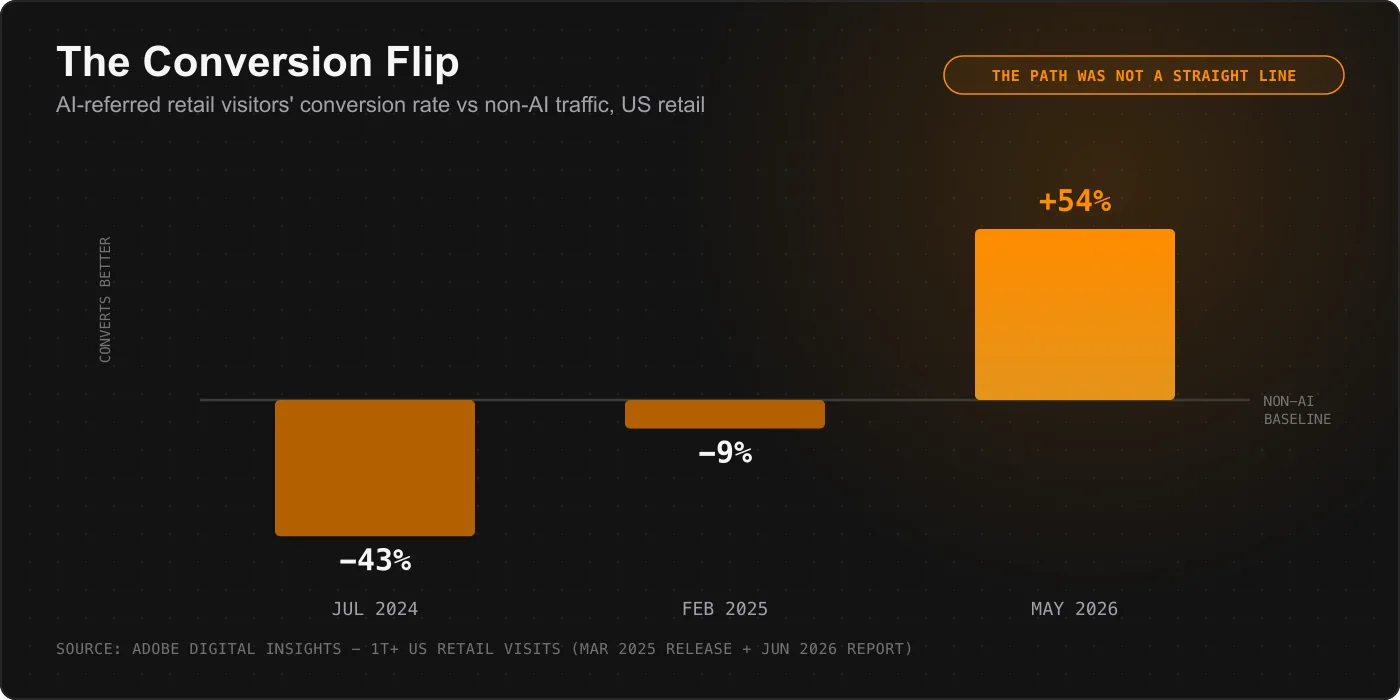
- The conversion gap flipped in under two years: AI-referred retail visitors went from converting 43% worse than other traffic (July 2024) to 54% better (May 2026), per Adobe.
- AI referrals were roughly 0.2% of total site traffic at the end of 2025. High quality, still low volume.
- ChatGPT's product results cannot be bought: OpenAI states they are organic and unsponsored, fed by product feeds and the product pages themselves. Shopify catalogs are integrated automatically.
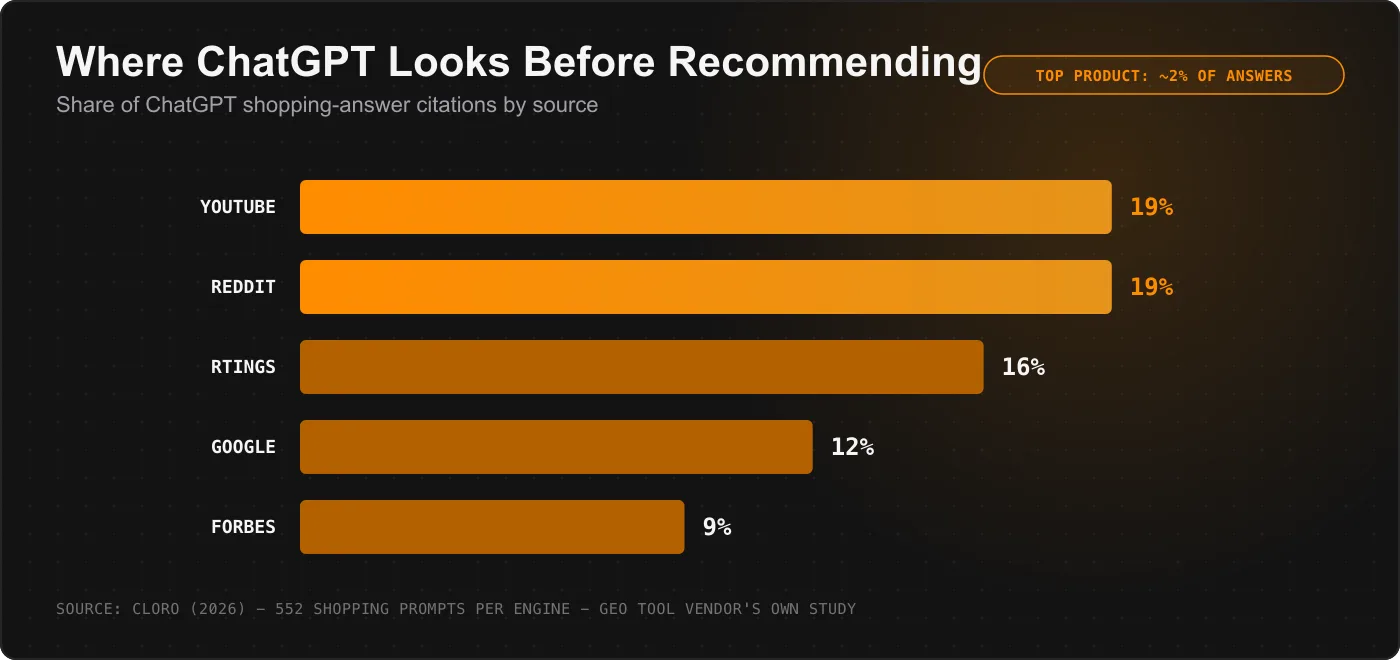
- For shopping prompts, ChatGPT's most-cited sources in one study were YouTube (19%), Reddit (19%), and the reviews lab RTINGS (16%). Third-party evidence, not your homepage, earns the mention.
Definition: GEO for DTC
GEO for DTC is the discipline of increasing how often, and how accurately, AI engines mention and recommend a consumer brand's products when shoppers ask for suggestions. It differs from B2B GEO in where the evidence lives: engines answering shopping prompts lean on product feeds, product-page data, video reviews, community threads, and independent testing sites, so the work spans feed and schema plumbing, product-page clarity, and earned third-party coverage rather than whitepapers and analyst citations.
Are consumers actually shopping with AI yet?
Consumers are already using AI to shop, but the traffic contribution remains tiny. On the adoption side: Adobe's survey of more than 5,000 US consumers found 39% have used generative AI for online shopping and 53% planned to this year, with product research (55%) and recommendations (47%) the top uses (Adobe, March 2025). The traffic trend matches: generative AI referrals to US retail sites grew 1,300% year over year in holiday 2024, and by May 2026 they were still growing 138% year over year at their highest share of retail visits on record (Adobe Digital Insights, June 2026).
Those multiples grow off a small base, though. Contentsquare's cross-industry benchmark put AI referrals at 0.2% of total site traffic in Q4 2025, even after 632% year-over-year growth (Contentsquare, January 2026), and an academic analysis of 973 ecommerce sites through July 2025 found ChatGPT driving under 0.2% of traffic (Kaiser and Schulze, Marketing Science). Adobe's own reports publish growth rates, never AI's share of total retail traffic. AI traffic remains small, but it is growing quickly from a low base.
Key takeaway: 39% of US consumers have tried AI shopping and the referral trendline is compounding triple digits, but AI was still roughly 0.2% of site traffic at the end of 2025. Size the investment to the trajectory, not the current volume.
What is an AI-referred shopper actually worth?
Adobe's measurements reversed between July 2024 and May 2026: AI-referred visitors moved from underperforming to outperforming other traffic. The sequence runs from converting 43% worse than non-AI traffic in July 2024 to roughly 9% worse by February 2025 to 54% better by May 2026, with 53% more revenue per visit (Adobe Digital Insights, June 2026). The path was not a straight line (the gap widened again mid-2025 before flipping), but the direction is consistent: these visitors appear to arrive with greater purchase intent.
The most DTC-relevant dataset says the same thing at brand scale. Across 94 seven- and eight-figure ecommerce stores, ChatGPT referral traffic converted at 1.81% against 1.39% for non-branded organic search, a 31% edge, and grew 1,079% across 2025. It also produced $474K in revenue against organic's $32.1M, about 1.5% (180 Marketing, February 2026). And much of the AI influence never shows up labeled as AI at all: Similarweb found shoppers who got a ChatGPT brand recommendation were 2.5 times more likely to visit that brand's site within a week, with most of those visits landing in analytics as branded search rather than AI referrals (Similarweb, June 2026). In other words, standard attribution undercounts this channel, and the size of that undercount is worth measuring properly.
How do ChatGPT, Google, and Perplexity actually pick products?
Each engine now has real product plumbing a DTC brand can connect to, and none of the three sells the recommendation itself:
| Engine | How products get in | Paid influence on recommendations |
|---|---|---|
| ChatGPT | Product feed spec (title, description, price, availability, brand, eligibility flags) (OpenAI); Shopify catalogs sync automatically (Shopify); shopping research also reads product pages directly | None claimed: "Product results are selected independently by ChatGPT and are not ads" (OpenAI); ads exist since 2026 but run separately |
| Google AI Mode / AI Overviews | Shopping Graph grounded in Merchant Center feeds, 50+ billion listings (Google); "no additional requirements" beyond normal indexing (Google Search Central) | Google does mix ads into AI surfaces, so organic product grounding and paid placement coexist |
| Perplexity | Merchant program for catalog data, with PayPal-powered Instant Buy checkout; product cards "aren't sponsored" (Perplexity) | None claimed for the cards; sponsored questions are a separate ad product |
Two caveats matter. First, checkout keeps shifting: OpenAI launched Instant Checkout with Etsy in September 2025, trade press reported a retreat toward discovery-first in early 2026, and OpenAI's own current docs still describe the option for some merchants, so build for discovery and treat in-chat checkout as a bonus. Second, OpenAI's "organic and unsponsored" is a policy statement, not an audited fact; it is also the best commitment any of the three engines has put in writing.
Which DTC brands get recommended, and why?
Not simply the biggest ones, and never consistently. SparkToro's headphone experiment ran 142 differently worded prompts repeatedly, collecting 994 responses, and found even the category's dominant brands (Bose, Sony, Sennheiser, Apple) appearing in only 55% to 77% of answers (SparkToro, January 2026). Semrush's consumer-electronics data makes the size point directly: Samsung led at 58.08% share of voice and Apple held 48.84%, but Garmin reached 31.15% while selling only wearables and GPS devices, a sliver of its rivals' catalogs (Semrush, September 2025). A focused brand the engines can describe precisely competes far above its size, the same mechanism we documented in why AI recommends your competitor instead of you.
One study of ChatGPT's shopping citations found YouTube and Reddit tied at 19% each and the independent testing site RTINGS at 16%, ahead of Google at 12% and Forbes at 9%, with recommendations so long-tail that the single most-recommended product appeared in only about 2% of answers (cloro, 2026, a GEO tool vendor's study, so weigh accordingly). The pattern holds elsewhere with big category differences: in one Google AI Overviews holiday analysis, YouTube took 78% of electronics citations while apparel split nearly evenly between YouTube and Reddit (BrightEdge). The engines go looking for video reviews, community threads, and lab testing. Product pages provide the facts, while external reviews and discussions often determine whether those facts are trusted.
Key takeaway: Dominant brands appear in barely three-quarters of their own category's answers, focused brands punch above their size, and the deciding evidence lives on YouTube, Reddit, and review sites more than on any brand's own domain.
What should a DTC brand actually do?
Five moves, in the order they pay off:
- Connect the plumbing. Submit the ChatGPT product feed (automatic if you are on Shopify), keep Merchant Center complete and current, and make sure product schema states price, availability, and variants machine-readably.
- Make product pages quotable. ChatGPT's shopping research reads PDPs directly. Specific, factual, self-contained product copy is what a model can lift with confidence; write content AI engines can actually cite.
- Earn the third-party evidence. Video reviews, community presence, and independent testing drive shopping citations. Seeding reviewers and participating honestly where your buyers ask questions is now search work, not just PR.
- Measure your recommendation rate. Run a buyer-question panel across the engines and track share of voice against the brands actually being named, at a defensible sample size.
- Ignore rank promises. The same shopping prompt almost never returns the same list twice, and results also vary with model, date, location, and prompt wording. Recommendation frequency across a sufficiently large prompt sample is more defensible than a ranking from any single response.
Key takeaway: Feed and schema plumbing first, quotable product pages second, earned third-party evidence third, measured share of voice always. None of these steps works as a one-time project: product data, third-party evidence, and recommendation measurements all need to be maintained.
Frequently Asked Questions
Do consumers actually use AI to shop yet?
39% of US consumers say they have used generative AI for online shopping and 53% planned to (Adobe's 5,000-person survey), yet AI referrals were still only about 0.2% of total site traffic at the end of 2025. Adoption is real and compounding fast, and the absolute volume is still small. Brands that wait for the volume to be undeniable will be competing against brands the engines already know.
Does AI-referred traffic convert for ecommerce?
Now, yes. Adobe measured AI-referred retail visitors converting 43% worse than other traffic in July 2024, 9% worse by early 2025, and 54% better by May 2026, with 53% more revenue per visit. A separate study of 94 seven- and eight-figure ecommerce brands found ChatGPT traffic converting 31% higher than non-branded organic search, while still producing under 2% of the revenue. High quality, low volume.
How do I get my products into ChatGPT?
Through content and a feed, not a check. OpenAI publishes a product feed spec (title, description, price, availability, brand, and per-product eligibility flags), Shopify merchants' catalogs are integrated automatically, and OpenAI states product results are organic, unsponsored, and cannot be bought. ChatGPT's shopping research also reads product pages directly, so a clear, complete product page is itself an input.
Why does AI recommend some DTC brands over much bigger ones?
Because engines reward legibility and third-party evidence over size. In Semrush's consumer-electronics data, Garmin held 31.15% share of voice against Samsung's 58.08% while selling only wearables and GPS, a fraction of Samsung's catalog. Focused brands that are consistently reviewed and clearly described can out-punch their size in AI answers.
Which sources decide AI product recommendations?
For shopping prompts specifically, one study of ChatGPT's citations found YouTube and Reddit tied at 19% each, with the reviews lab RTINGS at 16%, ahead of any brand's own site. Video reviews, community threads, and independent testing are where the engines look for evidence, which makes earning that third-party coverage a core GEO activity for DTC brands.
How Etched runs GEO for DTC brands
The same evidence-distribution model we run for B2B SaaS, tuned for commerce: feed and schema plumbing underneath, quotable product content and earned third-party coverage on top, all measured as share of voice against the brands the engines actually recommend in your category.
Want to know whether ChatGPT recommends your products or someone else's? Run the free AI visibility check for an instant snapshot, or book the $5,500 GEO Audit for the full prompt-panel measurement across every engine your buyers use.
Run the free AI visibility check


