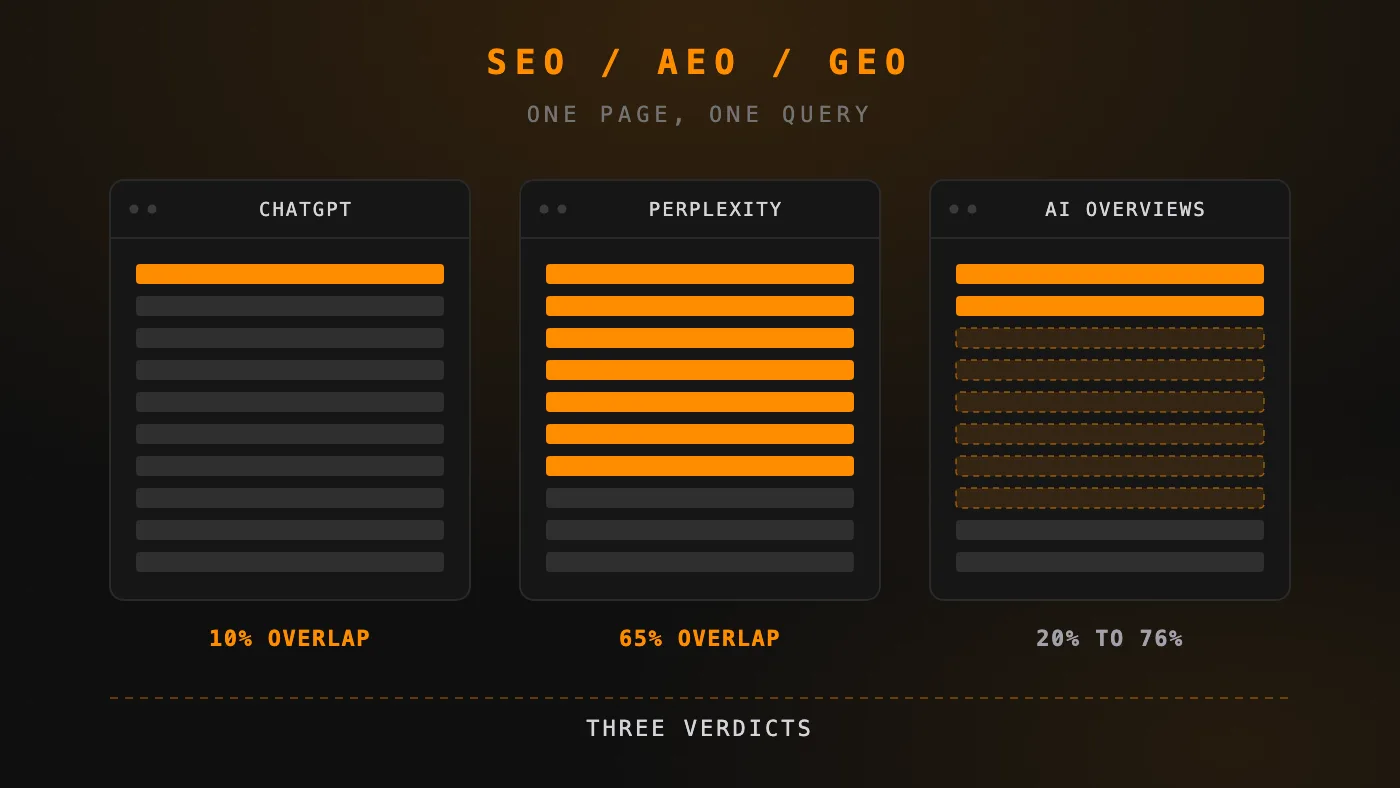
SEO, AEO and GEO describe nearly the same work: making a page accurate, well structured, and easy to quote. What changes a plan is which engine you are trying to appear in. Published measurements of how far a Google ranking carries into an AI answer range from 10% to 76%, and that spread comes from which engine was tested and how each study counted a citation.
Key Takeaways
- Conductor's 2026 benchmarks report carries both AEO and GEO in its title, uses AEO throughout the body, and never defines GEO or distinguishes the two.
- In one Ahrefs study of 3,311 queries, 10.00% of the URLs ChatGPT cited also ranked in Google's top 10. For Perplexity the same measurement was 65.07%.
- Ahrefs and Semrush measured AI Overview overlap with the top 10 at 76.1% and 20% to 26% in studies a day apart. Ahrefs then revised its own figure to 37.9% in March 2026.
- GEO comes from a 2024 academic paper whose "up to 40%" headline is a lift in a visibility metric the authors invented, not in traffic or revenue.
- AI referrals were 1.08% of website traffic across the 10 industries in Conductor's May to September 2025 United States data, which covered 13,770 domains.
Definition: Answer engine optimization (AEO)
Work aimed at being the answer a system returns rather than a link in a ranked list. The term predates generative chatbots and grew out of featured snippets and voice assistants, where a single response replaced a page of results.
What do SEO, AEO and GEO actually mean?
Search engine optimization aims at a ranked list of links. Answer engine optimization aims at the single response that replaces that list, a goal that existed before ChatGPT, back when the answer came from a featured snippet or a smart speaker. Generative engine optimization is the newest of the three, and it starts in one place: a paper called "GEO: Generative Engine Optimization" by Pranjal Aggarwal and co-authors, presented at KDD 2024, which coined the term and proposed a way to measure it. That gives GEO a traceable origin the other two acronyms lack.
| Term | Target | Where it came from | What you are trying to win |
|---|---|---|---|
| SEO | Ranked links | Commercial web search | A position in the results |
| AEO | A single answer | Featured snippets and voice | Being the response |
| GEO | Generated text | A 2024 academic paper | Being quoted inside the answer |
The trouble is that the boundaries are not enforced. One example sits in the industry's own research. Conductor published The 2026 AEO / GEO Benchmarks Report, which puts both acronyms in the title, expands AEO as answer engine optimization, uses AEO throughout the body, and never defines GEO or says how it differs. GEO appears in the title and the page labels, then disappears.
Whatever the reason, a vendor with this much data shipped both words in the title and then used only one of them in the analysis.
Does ranking on Google get you cited by AI?
This is the question the acronym argument stands in for. The answer differs by engine.
Ahrefs ran 3,311 short-tail queries through ChatGPT, Perplexity and Google in a September 2025 study, then checked how often the cited URLs also appeared in Google's top 10. For Perplexity, 65.07% did. For ChatGPT, 10.00% did. Measured more loosely, at the level of the domain rather than the exact page, the figures were 80.58% and 31.80%.
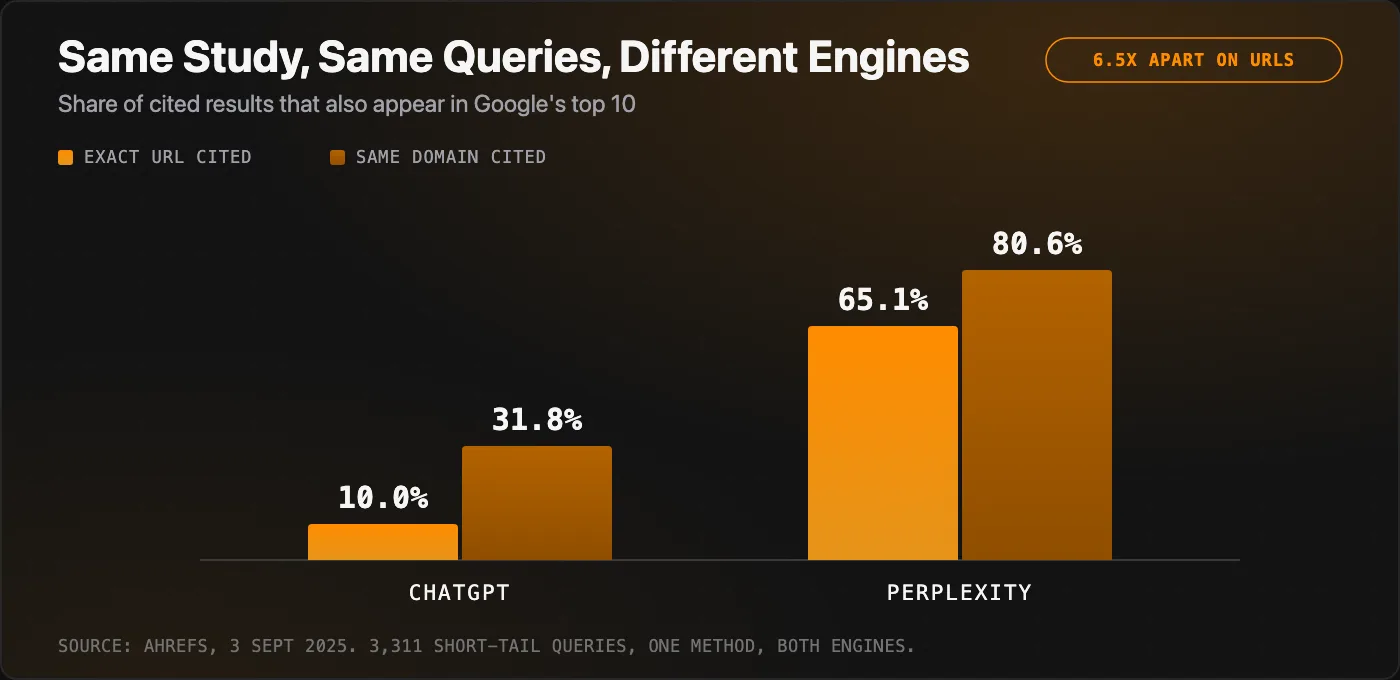
One study, one method, one set of queries, and the answer to "is AEO just SEO?" changes by a factor of six depending on which engine you ask about. For a brand whose buyers research in Perplexity, existing search work carries most of the way across. For a brand whose buyers research in ChatGPT, it mostly does not, and a search program was not designed to cover that gap.
Key takeaway: The question of whether search rankings transfer to AI answers has no single answer. Measured the same way on the same queries, Perplexity's overlap with Google's top 10 was 65.07% and ChatGPT's was 10.00%.
A third figure, 6.82%, comes from a different Ahrefs analysis of query fan-out on a different sample. Ahrefs says so itself, noting that the percentages represent different studies and different sized datasets. Perplexity is a useful illustration: 65.07% on these short-tail queries, and 28.6% on a separate set of 15,000 long-tail prompts. Same engine, same publisher, not interchangeable.
Why does this number keep moving?
In July 2025, Ahrefs and Semrush published studies a day apart asking how often Google's AI Overview cites a page that also ranks in the top 10. Ahrefs reported 76.10%. Semrush reported 20% to 26%.
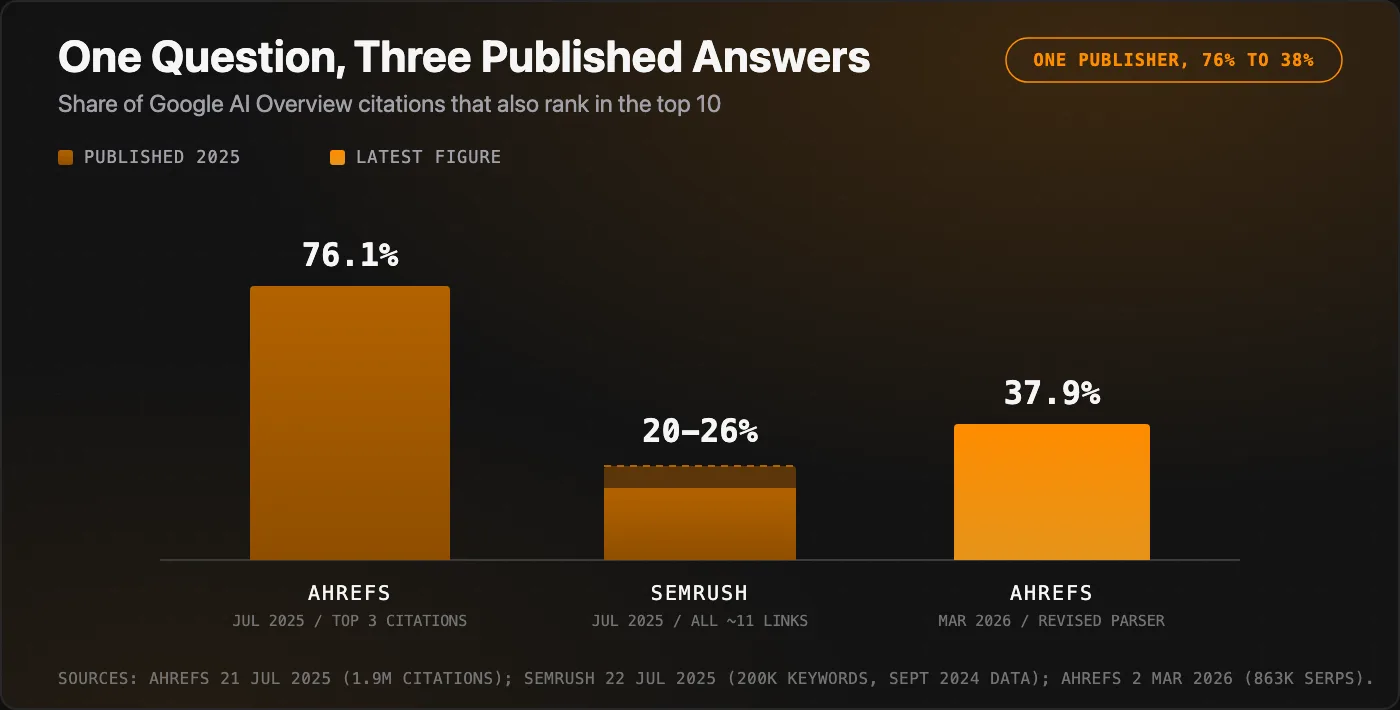
The two studies counted different things. Ahrefs analyzed 1.9 million citations and looked at the three most visible citations in each answer. Semrush looked across 200,000 keywords at every link in the Overview, averaging 11 per answer. The most prominent citations plausibly skew toward pages that already rank well, while the full set of eleven does not. Semrush collected its data in September 2024, and Ahrefs does not publish a collection window for its July 2025 study.
Then Ahrefs revisited the question. In March 2026 it published 37.9% across 863,000 keyword SERPs and 4 million cited URLs, and stated the change plainly: around 76% in July 2025 against around 38% today. The same publisher, asking the same question, moved by half in eight months.
At least three things changed in that window. Ahrefs says AI Overviews now draw more on fan-out query results than on the original SERP. It also improved its parsing so it could see more citations than before. And AI Overviews moved to Gemini 3 in January 2026. The published data does not separate a genuine shift in Google's behavior from a change in how the measurement was taken, and Ahrefs does not claim that it does.
So the useful conclusion is about shelf life. Any overlap figure you are quoted describes one engine, one sampling method, and one month. Ask when it was taken before you plan against it.
What actually moved visibility in a controlled test
The GEO paper is a controlled experiment on the question. The authors built GEO-bench, 10,000 queries across 25 domains, and tested content modifications against it.
The methods that worked were citing sources, adding quotations, and adding statistics, which produced relative improvements of 30% to 40% on one metric and 15% to 30% on the other. Keyword stuffing, carried over from traditional SEO, performed poorly.
Two details limit what the result supports. Those metrics are Position-Adjusted Word Count and Subjective Impression, and the authors defined both. "Up to 40%" describes a lift in how much space and prominence a source gets inside a generated answer. It is not a traffic forecast, a click estimate, or a revenue projection, and anyone quoting it as one has changed what the paper said. What the experiment supports is narrower and still useful: on a large query set, content that cites and quantifies got more room in the answer than content that repeated keywords.
How much traffic is actually at stake?
Less than the vocabulary suggests, for now. Conductor measured AI referrals at 1.08% of all website traffic across the 10 industries it analyzed, drawn from 13,770 domains of leading brands in the United States between May and September 2025, with ChatGPT responsible for 87.4% of it.
The average varies widely by industry. Information Technology saw 2.80%, while Communication Services saw 0.25%, an elevenfold spread between industries in the same dataset. Whether this work is urgent for you is an empirical question about your category, not a general one.
The forecast usually cited to argue otherwise is Gartner's February 2024 prediction that traditional search engine volume would drop 25% by 2026. That deadline has now arrived. The forecast described query volume and is routinely restated as a drop in website traffic, a distinction we covered in GEO for fintech. We have not found a public dataset that settles whether the drop happened.
Key takeaway: AI referrals were 1.08% of website traffic in Conductor's 2025 United States data, ranging from 0.25% in Communication Services to 2.80% in Information Technology.
So which one should you buy?
Ask a vendor which engines they measure, how many times they run each query, and what they will show you when the number moves. The measurement plan predicts the quality of the work better than the acronym on the proposal does.
In practice that means a few things:
- Name the engines that matter for your category rather than buying "AI visibility" in the abstract. The overlap data says ChatGPT and Perplexity are different problems.
- Establish a baseline before any work starts, and keep the raw answers. Our guide to measuring brand visibility in AI search covers what to record.
- Decide the number of repetitions in advance. A single query is an anecdote, and tracking AI mentions explains the sample sizes involved.
- Keep the technical work going. Pages still need to be accurate, structured, and crawlable, which is what schema markup and content built to be cited are for.
A proposal that cannot answer those questions has a bigger problem than its vocabulary. What GEO actually costs covers the published price ranges, and why AI recommends your competitor covers what tends to predict who gets named.
How Etched approaches this
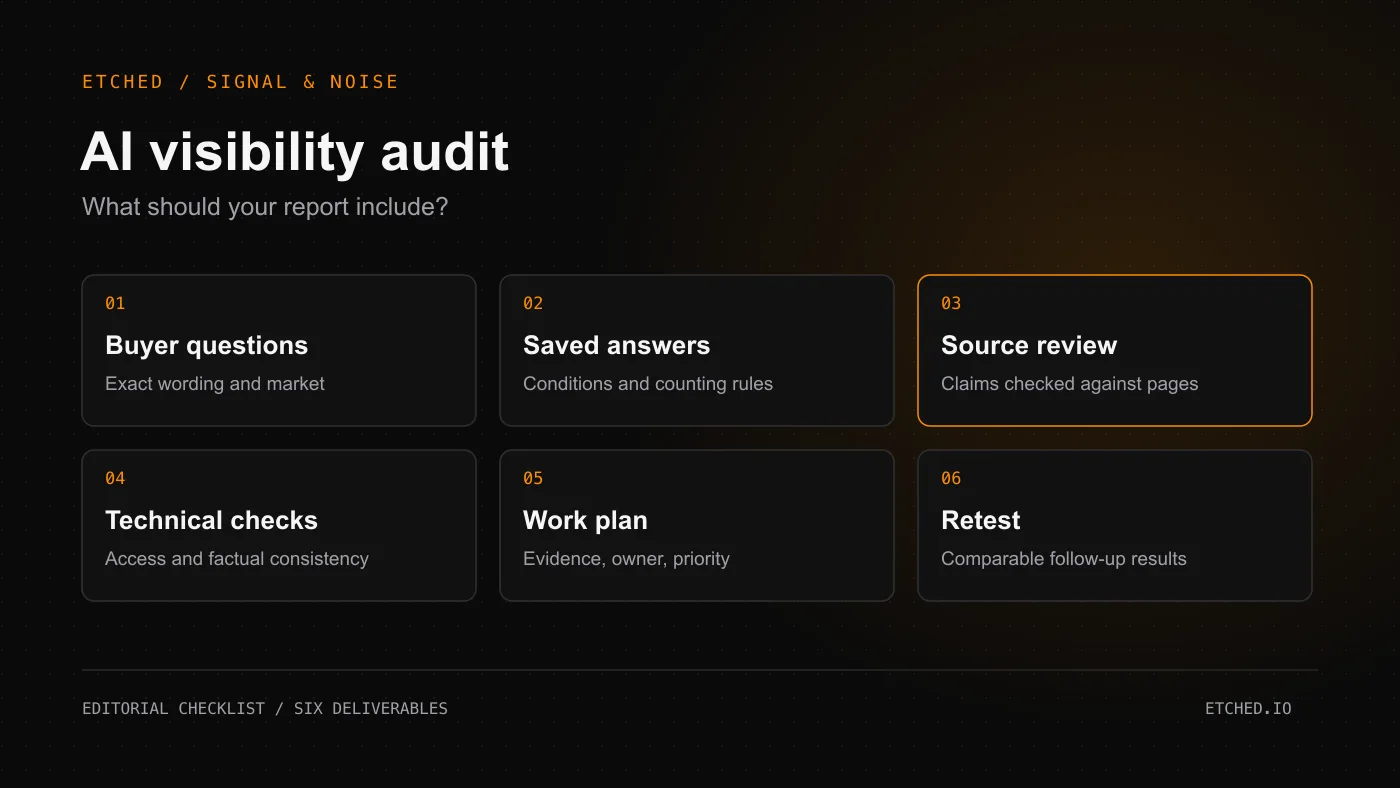
We do not sell the acronym argument. An engagement starts with a documented baseline across the engines that matter for your category, with the raw answers kept so later claims can be checked against them. Our AI visibility audit guide sets out what that report should contain, whoever produces it.
You can run the free AI visibility check to see how the engines currently describe your brand, and pricing sets out what the focused audit and the ongoing work cost.
Related Services
Frequently Asked Questions
Is AEO just a new name for SEO?
It depends on the engine, and the gap is large enough to matter. In an Ahrefs study of 3,311 short-tail queries, 65.07% of the URLs Perplexity cited also ranked in Google's top 10, against 10.00% for ChatGPT. For Perplexity, strong search rankings carried most of the way into AI answers. For ChatGPT in that sample, they did not.
What is the difference between AEO and GEO?
In practice there is rarely a working difference, and vendors do not agree on one. Conductor's 2026 benchmarks report carries both terms in its title, expands AEO as answer engine optimization, uses AEO throughout the body, and never defines GEO or explains how the two differ.
Where does the term GEO come from?
A 2024 academic paper, "GEO: Generative Engine Optimization" by Aggarwal and co-authors, presented at KDD 2024. The paper coined the term and tested content changes against a 10,000-query benchmark the authors built.
Does the GEO paper prove optimization increases traffic?
No. Its headline claim of up to 40% is a lift in Position-Adjusted Word Count, a visibility metric the authors defined, measured inside generated answers. The paper does not measure clicks, traffic, or revenue, so the number should not be read as a traffic forecast.
How much traffic do AI assistants actually send?
Across the 10 industries Conductor analyzed in its United States data for May to September 2025, drawn from 13,770 domains, AI referrals were 1.08% of all website traffic, and ChatGPT accounted for 87.4% of it. The average hides wide variation: Information Technology saw 2.80% and Communication Services 0.25%.