
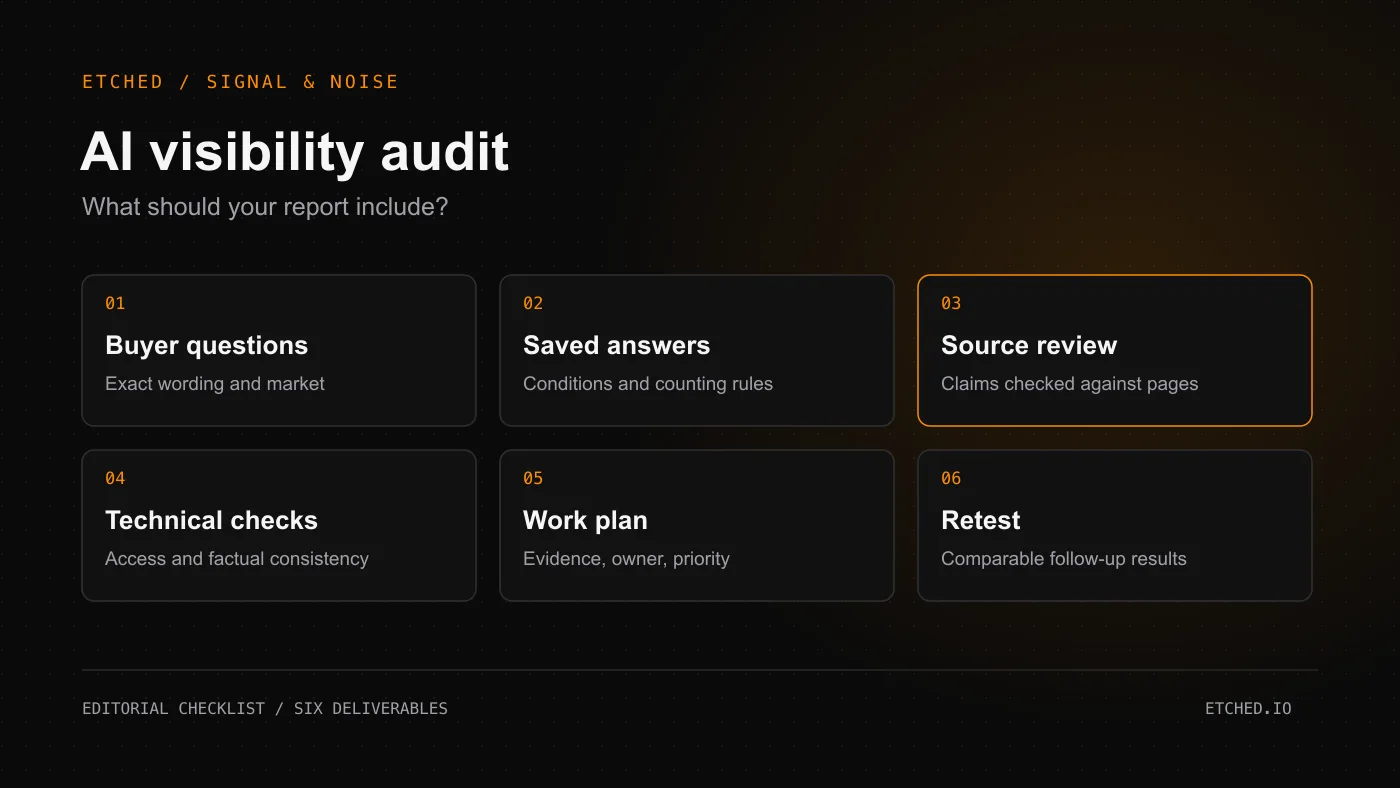
An AI visibility audit should show how your business appears in selected AI answers, whether those answers are accurate, which sources they cite, and what deserves fixing. You should receive the questions, saved responses, technical findings, and a prioritized action plan, with enough detail to check the conclusions yourself.
If you're considering generative engine optimization (GEO) or answer engine optimization (AEO), ask to see an anonymized sample report before buying. Look for a clear path from each finding to the proposed work. A visibility score needs an explanation: what was tested, how it was counted, and what the result tells you about potential customers.
AI visibility audit checklist: six deliverables to ask for
Before comparing reports, compare scope. Ask each provider to specify the products and interfaces tested, markets and languages, number of questions, repetitions, collection dates, and pages reviewed. The proposal should also state whether implementation and retesting are included in the fee.
| Deliverable | What you should be able to inspect |
|---|---|
| Buyer question set | Exact prompts, intended customers, markets, and the reason each question matters |
| Saved answer baseline | Full answers, collection dates, product and search mode, repeated observations, and scoring rules |
| Source review | The cited URLs, the claims they support, and any inaccurate information about your business |
| Technical access checks | Page-level evidence of crawling, indexing, rendering, or access issues relevant to the products tested |
| Prioritized work plan | Specific changes, supporting evidence, an owner, and a way to verify completion |
| Retest and business measures | A comparable follow-up method, plus referral traffic and qualified inquiries where measurable |
Ask the report to distinguish confirmed defects from ideas that still need testing. That distinction should affect which work gets funded first.
1. Buyer questions that reflect a purchase decision
The question set should include situations in which someone could reasonably choose your business.
For an accounting firm, that might mean asking which firms handle multistate sales tax for ecommerce businesses. Asking about the firm's name directly tests whether the assistant can identify and describe it. Report those results separately from questions that do not name the firm.
| Question type | Illustrative prompt | What it tests |
|---|---|---|
| Brand description | "What services does [Company] offer?" | Whether the answer identifies and describes the business accurately |
| Discovery | "Which accounting firms help ecommerce companies with multistate sales tax?" | Whether the business appears without being named in the question |
| Comparison | "How do [Company] and [Competitor] compare for a growing ecommerce business?" | What the answer says when both businesses are supplied |
| Selection | "What should we ask an accounting firm before hiring it for multistate sales tax?" | Whether the company's expertise or resources appear during evaluation |
The table contains illustrative prompts.
Ask where the questions came from. Sales calls, customer emails, support requests, and search data give the team a business reason to test them. A generated list can supply ideas, but someone who understands your customers should review it.
Keep important constraints in the wording: geography, company size, use case, and budget when relevant. Record how many questions name your brand. A report dominated by branded questions can look encouraging while saying little about discovery.
2. Saved answers with clear scoring rules
Record the conditions under which each answer was collected.
OpenAI explains that ChatGPT can rewrite a question for search and use location information and relevant saved memories. [1] An auditor's account settings can therefore matter to the test. Record the interface, search mode, market, date, and session conditions; starting a new chat alone does not document those conditions.
For each observation, retain the exact prompt, full answer, cited URLs, and enough collection detail to repeat the exercise. Label API collection and consumer-app collection separately.
Define these outcomes before calculating a score:
- Mention: The business appears by name.
- Recommendation: The answer presents it as a suitable option for the buyer's stated need.
- Owned-site citation: The answer cites a page on the business's website as support. Record citations to third-party pages separately.
- Checked-claim accuracy: Count assessed claims as supported, contradicted, or unresolved, and retain the evidence used for each decision.
A business could be recommended using a third-party review as the cited source. Its own article could also be cited in an answer that recommends another supplier. Report both situations accurately.
Repeat important questions under comparable conditions and show the counts. If a hypothetical test produces recommendations in 6 of 20 completed runs, report "6 of 20 in this test." Those observations do not establish how often all buyers see the company.
Document failed requests, refusals, and answers without search separately. Small exploratory checks can uncover problems; broad claims about recommendation frequency need a stronger measurement design. Our guide to tracking AI mentions covers that distinction in more detail.
3. A source review that checks the actual claims
Open the cited pages and check what they support.
In a 2025 study by Columbia's Tow Center, researchers tested eight AI search tools using 1,600 queries asking them to identify news articles from excerpts. The researchers documented incorrect attribution and fabricated links. That was a news-retrieval test, not a measurement of business recommendations, but it demonstrates why a citation needs inspection. [2]
For a business audit, check claims that could affect a purchase: services, locations, integrations, pricing, eligibility, and limitations. Compare them with current company information and the source the answer actually cites.
Separate the observation from the explanation. Suppose an answer states an old minimum contract value and links to a directory containing that figure. You can establish that the answer and directory agree, and that both conflict with the current pricing page. You have a concrete correction to pursue.
You have not established that the directory caused every answer to use the old price. Preserve that distinction in the report.
The useful deliverable is a list of checked claims, their supporting URLs, any contradictions, and the changes worth pursuing. A list of domains alone leaves that work unfinished.
4. Technical checks for the products you tested
Check the pages that answer the buyer's question: service pages, product documentation, comparisons, pricing, and relevant articles.
For ChatGPT search, OpenAI identifies OAI-SearchBot as its search crawler. Its controls are independent of GPTBot, which relates to potential model training. A publisher can allow search access while disallowing training access. OpenAI also advises allowing requests from its published searchbot IP ranges. Its ChatGPT-User agent handles certain user-requested page visits and does not determine search inclusion. Record access findings for that agent separately. [3]
For Google, review indexing and snippet eligibility alongside the current Search generative AI setting in Search Console. Google's documentation says inclusion is the default, with settings that can be inherited from a parent property. Record the effective setting for the property being audited. [4][5]
The technical report should identify each checked URL, the issue found, and the evidence. Relevant checks include server responses, robots directives, access challenges, canonical URLs, and whether important information is available in the content the system can access.
After correcting an access block, verify that the affected page can be retrieved. Record successful access separately from later citation or recommendation results.
Also inspect structured data against the visible page. Google requires markup to represent the content accurately and warns against hidden or misleading claims. Our guide to schema markup for AI search explains its appropriate role. [6]
5. A prioritized work plan tied to findings
Every proposed task should connect to an observed problem or a clearly stated hypothesis.
Here is an illustrative way to write the findings:
| Finding | Proposed work | Completion check |
|---|---|---|
| A relevant service page has an unintended indexing restriction | Remove the restriction and review indexing | Confirm the corrected directive and subsequent index status |
| Current pricing conflicts with a company-controlled profile | Correct the outdated profile | Verify both locations show the current terms |
| Buyers ask about an integration that the product supports, but the site does not explain | Publish reviewed documentation covering support and limitations | Confirm accuracy, accessibility, and useful internal links |
| A competitor appears in one collected answer | Collect further comparable observations before proposing a large content project | Determine whether the observation recurs and which sources appear |
For each task, include an owner, scope, and expected effort. Explain its priority using the buyer impact and strength of the evidence. Identify dependencies, including requests to directories or publications that the company cannot complete itself.
Ask for the evidence behind any task presented as mandatory. Google explicitly says it does not use llms.txt for Search and does not require special schema for its generative AI features. It also says content does not need to be broken into tiny pieces for those features. Those statements apply to Google Search; they should not be stretched into claims about every AI product. [4]
A sensible plan can still include structured data, clearer writing, or better documentation. It should explain the actual problem those changes address.
6. A retest connected to business results
Agree on the follow-up method before implementation begins.
Keep a core set of questions stable, record product and collection conditions, and retain a dated change log. If the team adds new questions, report them separately so a different question mix does not masquerade as improvement.
A before-and-after comparison can show an observed change. It cannot, by itself, isolate your edits from product updates, competing content, or other changes outside your control.
Track three layers:
- Completed work: Were the agreed corrections shipped and verified?
- Observed answers: Did recommendations, citations, and checked facts change under the stated test conditions?
- Business outcomes: Did identifiable referrals, qualified inquiries, or sales change?
Google's Generative AI performance report provides impression data for AI Overviews and AI Mode. Check whether it is available for the property and review the current eligibility guidance before interpreting a missing report. Its impressions measure links shown in those features, separately from recommendations in a collected prompt set. [7]
Use website analytics and CRM records to follow identifiable visits through to inquiries. Ask prospects how they found you as well. Keep their answers distinct from tracked referrals rather than assigning every unexplained lead to AI.
Questions to ask before commissioning an audit
Can I run an AI visibility audit myself?
You can begin with a small set of real buyer questions, saved answers, and a review of the cited pages. Treat it as an exploratory check. A larger engagement should justify its cost through the depth of investigation, technical work, and decisions it enables. See Etched's audit scope and measurement rules.
Does a free brand checker replace an audit?
Check what the tool tests before interpreting its score. Questions that name your company measure a different situation from supplier searches that leave it unnamed. A full audit should provide the saved answers and investigation described above. Etched's free AI visibility checker is hosted by Trafiq and asks for an email before showing results. Review its scope before treating the snapshot as a discovery baseline.
Can an agency guarantee that ChatGPT will recommend us?
OpenAI says placement in ChatGPT search is not guaranteed. Ask an agency to commit to defined deliverables, documented changes, and a transparent measurement process. [1]
What should we do first?
Choose a buyer question that matters to your business and inspect the answer, its sources, and any claims about your company.
We can run a few buyer prompts and talk through what the answers suggest. Book a free call with Etched.
Sources
Platform documentation checked October 19, 2026. The Tow Center study was published March 6, 2025.
- OpenAI, Searching the web with ChatGPT. Search behavior, personalization, source verification, and placement eligibility.
- Klaudia Jaźwińska and Aisvarya Chandrasekar, Tow Center for Digital Journalism, AI Search Has a Citation Problem, March 6, 2025. Original research and methodology.
- OpenAI, Overview of OpenAI Crawlers. Separate search, training, and user-initiated access controls.
- Google Search Central, Optimizing your website for generative AI features on Google Search. Technical eligibility, content guidance, and unsupported Google Search tactics.
- Google Search Console Help, Search generative AI control. Inclusion settings, defaults, and property inheritance.
- Google Search Central, General structured data guidelines. Visible content, accuracy, and markup requirements.
- Google Search Console Help, Generative AI performance report for Search. Covered features, impression data, and report availability.


