
At most companies, nobody owns AI visibility yet, and the agency-versus-in-house question is really a question about time and cost shape. Building in-house means a six-figure fully loaded hire, a 44-day average hiring cycle, and up to a year of ramp, in a talent market where the skill set barely existed two years ago. Hiring a GEO agency means paying $1,500 to $50,000+ per month for capability that starts working in weeks but never becomes yours. We run an agency, so read this knowing that, and knowing we will tell you when in-house is the right call anyway.
Key Takeaways
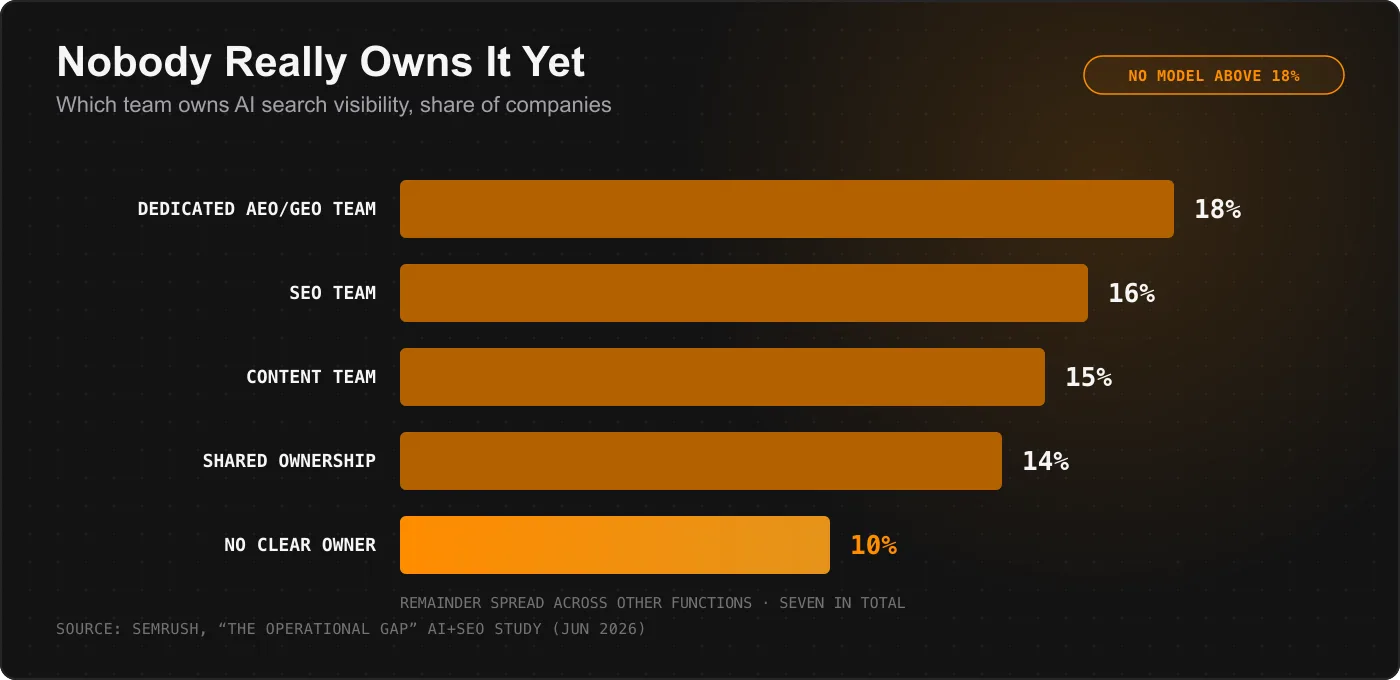
- Ownership of AI search is scattered across seven functions with no single model above 18%, and one in ten companies has no clear owner at all (Semrush, June 2026).
- 84% of marketers say they're confident they can shape AI answers, yet 56% are unsure how AI search optimization even differs from SEO. Confidence is running far ahead of competence.
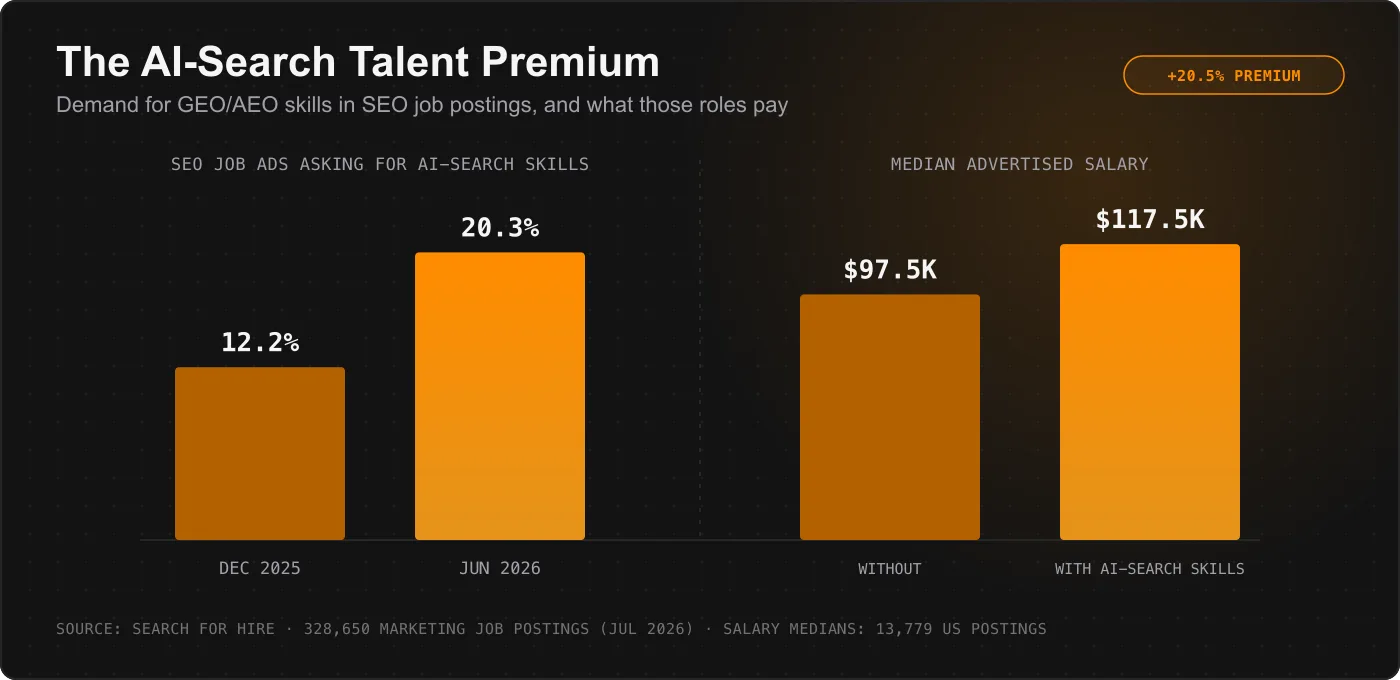
- The talent is scarce and priced accordingly: 20.3% of SEO job ads now ask for AI-search skills, up from 12.2% six months earlier, and those roles pay a 20.5% median salary premium ($117,500 vs $97,500).
- A senior in-house hire lands around $143K to $161K fully loaded before tools; published agency retainers run $1,500 to $50,000+ per month. Neither number comes from a neutral source, and we name which vendor published each one.
- There is no credible independent evidence that either model outperforms the other. The most-circulated comparison stat is untraceable. Decide on speed, cost shape, and knowledge retention instead.
Definition: AI Visibility Ownership
AI visibility ownership is the question of which team is accountable for how a brand appears in AI-generated answers: measuring presence across ChatGPT, Gemini, Claude, and Perplexity, fixing the entity and content gaps the measurement finds, and reporting the trend. It spans work that traditionally sits in three different places (SEO, content, and analytics), which is exactly why, at most companies, it currently sits nowhere.
Who owns AI visibility inside companies today?
Mostly nobody, and the data on this is unusually clear. Semrush's June 2026 study of how teams are operationalizing AI search found responsibility scattered across seven different functions, with no single ownership model above 18%: a dedicated AEO/GEO specialist or team leads at 18%, followed by the SEO team at 16%, content at 15%, shared ownership at 14%, and a full 10% of companies with no clear owner at all (Semrush, June 2026). Only 22% of marketers in the same study said their SEO and AI search efforts are fully integrated.
The gap between confidence and competence makes the picture worse. A May-June 2026 survey by Scribewise and Scrunch found 84% of marketers confident they can shape AI answers, while 56% of the same population is unsure how AI search optimization differs from SEO at all (Scribewise + Scrunch, 2026). G2's Answer Economy interviews with B2B software marketers described the function the same way: early-stage, tactical, and fragmented, with attribution the loudest frustration (G2, 2026). This is the backdrop for the build-versus-buy decision. Neither option hands you a mature playbook: whoever you pick will be figuring out a two-year-old discipline on your budget.
What does it cost to build GEO in-house?
More than the salary line suggests, and the salary line is not small. Salary.com puts the average US SEO Director, the level of hire that can credibly lead the program, at $114,766 in base salary as of August 2026 (Salary.com). The standard rule of thumb for what an employee actually costs, from MIT's Joe Hadzima, is 1.25 to 1.4 times base once employment taxes and benefits land (MIT), and current government data backs the multiplier: benefits alone were 30.1% of private-industry employer compensation costs in March 2026 (BLS). That puts one director at roughly $143K to $161K per year before recruiting costs or a single tool subscription.
For GEO-titled roles specifically, the market is younger and stranger. A staffing firm tracking 50+ live AI-search postings in mid-2026 found specialists advertised at $75K to $95K, managers at $100K to $174K, and senior hires at $150K to $210K, and put the honest caveat better than we could: "the market hasn't settled, and anyone quoting you a tidy band is guessing" (Sloane Staffing, August 2026). The premium is measurable, too: 20.3% of SEO job ads now mention AI-search, GEO, or AEO skills, up from 12.2% just six months earlier, and roles asking for those skills pay a median of $117,500 against $97,500 without, a 20.5% premium (Search For Hire, July 2026).
Then add time. Average time to hire runs 44 days across industries per the Josh Bersin Company and AMS benchmark (2023 data; we found nothing newer at that scale), and Gallup's experience puts a new employee at around 12 months to reach peak performance (Gallup). Add tooling: a dedicated AI-visibility tracker runs $29 to $800+ per month depending on tier, before the SEO suite underneath it, a stack we priced line by line in our tools and method guide. And note that Profound, a GEO analytics vendor with an interest in the category looking well-resourced, describes a working mid-market program as a four-role effort running $75K to $150K per year all-in (Profound). A hire you start recruiting today is fully effective somewhere in late 2027.
Key takeaway: One senior in-house hire costs roughly $143K to $161K fully loaded, takes about 44 days to hire and up to a year to ramp, and still needs a several-hundred-dollar monthly tool stack. In-house is the more expensive path in year one for almost everyone below enterprise scale.
What does a GEO agency actually cost?
Every published number in this section, including ours, comes from someone selling something. With that stated: WebFX's 2026 cost guide, the most-cited benchmark, puts agency GEO at $1,500 to $5,000 per month for small-business scopes, $5,000 to $25,000+ for mid-market, and $25,000 to $50,000+ for enterprise (WebFX, May 2026). The nearest mature comparison is SEO retainers, where Ahrefs' poll of 439 providers found an average of $2,917 per month, with agencies at $3,209, though that poll predates the GEO era and skews low against current rates (Ahrefs). One tool vendor's survey even claims GEO retainers currently price below comparable SEO work, a median of $4,500 against $6,200 (Presenc AI, March 2026), though its methodology is not independently verifiable, so treat that as a vendor's claim rather than established fact.
For a concrete anchor with no survey ambiguity: our own GEO Audit is $5,500 one-time, and retainers start at $7,500 per month. That sits inside the mid-market band above, which should tell you the published ranges are at least directionally real.
What you are actually buying at those prices is time and accumulated reps: a team that has already run the measurement discipline across many brands, already knows why AI engines name one competitor over another, and starts producing a baseline in weeks instead of quarters. What you are not buying is permanence. The capability walks out the door when the contract ends, which is the strongest structural argument for the in-house path.
Is there real evidence one model outperforms the other?
No, and we looked hard, because a defensible number here would have made this article easier to write. The most-circulated comparison, 34% average organic traffic growth for agency-managed programs versus 28% for in-house versus 41% for hybrid, is attributed across the web to a "2025 Search Engine Journal survey of 1,200 businesses" that we could not find any trace of on Search Engine Journal itself. It appears only on agency-directory blogs, without a link to the study or even a named author. Every other agency-versus-in-house performance claim we found was authored by an agency or an agency directory. Treat the entire genre as marketing.
What the credible data does show is momentum toward building internally: Conductor's survey of 250+ enterprise leaders found 93% building AEO/GEO capabilities in-house and 94% planning to increase investment in 2026 (Conductor, January 2026), with the disclosure that Conductor sells an enterprise AEO platform to exactly those buyers. Set that 93% against the talent data above and the tension is obvious: nearly everyone wants to build in-house, in a market where the experienced practitioner pool, as writer Kaleigh Moore put it after counting 50+ open AEO roles in a two-week window, "barely existed 18 months ago" (Kaleigh Moore, July 2026). Something has to give, and in the near term it gives in the direction of salary premiums, long searches, and mis-hires.
One more argument that cuts both ways: the ground moves constantly. Profound's volatility research found that roughly 40 to 60% of the domains AI engines cite change within a single month (Profound, July 2025). That churn is an argument for a dedicated owner who stays current, and it is agnostic about whose payroll that owner sits on.
So who should own your AI visibility?
Decide on four dimensions, not on principle:
| Dimension | In-house | Agency |
|---|---|---|
| Year-one cost | ~$143K-$161K fully loaded per senior hire, plus tools, plus recruiting | $18K-$300K+ depending on scope (small-business through mid-market bands, $1,500-$25,000+/mo) |
| Time to first measured baseline | 44-day average hire, then ramp; realistically a quarter or more | Weeks; the prompt panels and process already exist |
| Talent risk | High: 20.5% salary premium, unsettled roles, mis-hire cost is yours | Low for you; the agency absorbs hiring and turnover |
| Knowledge retention | Compounds inside your walls permanently | Leaves when the contract ends unless the engagement is built to transfer it |
In-house is right when you already have a strong SEO team to extend (the Semrush data shows integrated teams are the minority, but they exist) and the scale to absorb a $150K+ specialist as a rounding error. It also helps if your category moves slowly enough that a year of ramp is affordable. An agency is right when you need a baseline and a working program this quarter, or when you cannot win a bidding war for scarce specialists. It is also the honest choice when the realistic in-house alternative is assigning "AI visibility" as a side project to someone who already has a full-time job, which the ownership data suggests is exactly what most companies have done.
The genuinely defensible long-term answer for most mid-market companies is sequenced: an agency to stand up measurement and fix the entity and content foundations, then an in-house owner to run and compound the playbook it hands over. If your engagement cannot end with your team knowing how it works, you bought dependency, not capability.
Key takeaway: Choose in-house for permanence at enterprise scale and an agency for speed and scarce expertise. For most mid-market teams the answer is a sequence: agency to build the system, in-house to keep it.
Frequently Asked Questions
Should I hire a GEO agency or build the capability in-house?
Decide on time and cost shape, not ideology. In-house means a roughly $143K to $161K fully loaded senior hire, a 44-day average hiring cycle, and up to a year of ramp before peak effectiveness. An agency costs $1,500 to $50,000+ per month depending on scope and starts producing a measured baseline in weeks. Most companies that succeed long-term end up hybrid: an agency to stand the program up, in-house to absorb it.
How much does a GEO agency cost per month?
Published 2026 ranges run $1,500 to $5,000 monthly for small-business scopes, $5,000 to $25,000+ for mid-market, and $25,000 to $50,000+ for enterprise. Treat every one of those numbers with care: as of August 2026 there is no neutral, third-party survey of GEO agency pricing, and every published range comes from a company selling GEO services or tools.
What does it cost to run GEO in-house?
A senior SEO hire capable of leading the program averages around $114,766 in base salary, which lands near $143K to $161K fully loaded using the standard 1.25 to 1.4x multiplier for taxes and benefits. Add an AI-visibility tracking stack at $29 to $800+ per month depending on tier, a 44-day average hiring cycle, and a ramp period Gallup puts at about 12 months to peak performance.
Who typically owns AI visibility inside a company today?
Usually nobody, cleanly. Semrush found responsibility scattered across seven different functions with no single model above 18%: dedicated AEO/GEO teams lead at 18%, then SEO at 16%, content at 15%, shared ownership at 14%, and one in ten companies has no clear owner at all.
Is there proof that agencies get better GEO results than in-house teams?
No. The most-circulated comparison (34% traffic growth for agencies vs 28% in-house vs 41% hybrid, attributed to a Search Engine Journal survey) is untraceable to any real study, and every agency-vs-in-house performance claim we could find was authored by someone selling one side of the decision. Anyone citing hard performance numbers for this choice is quoting marketing, not research.
How Etched structures engagements around this decision
We build engagements to end well, not to last forever: the $5,500 GEO Audit produces the measured baseline and the prioritized gap list, retainers execute against it, and the prompt panels and share-of-voice reporting are built to hand over to whoever owns this inside your company eventually. If that person exists today, we make them better; if they do not, we are the owner until you hire one.
Not sure the problem is big enough to staff at all? Run the free AI visibility check first. If AI engines already represent you well, this decision can wait, and knowing that costs nothing.
Run the free AI visibility check


